










Every sales team wants a full pipeline. The question is — how do you fill it the right way?
Some say the secret lies in lead generation services. Others swear by appointment setting. Both camps have a point, but here’s the catch: they’re not the same thing, and treating them as one is where most B2B strategies go off track.
I’ve seen this pattern across industries. Companies collect data, run campaigns, and celebrate hundreds of “leads,” but meetings don’t follow. Outreach slows down, sales get frustrated, and everyone starts questioning what went wrong.
The truth? Lead generation and appointment setting work best together, but only if you understand their distinct roles and functions.
After managing over 800 outbound projects at SalesAR, I’ve learned that the most significant wins occur when teams stop chasing volume and start building flow. This article unpacks how both functions fit into your sales process, what each delivers, and when it makes sense to invest in one or both.
The Sales Funnel Reality Check
Let’s start with the basics. The B2B funnel follows a simple path:
Awareness → Interest → Engagement → Meeting → Deal
Lead generation encompasses awareness and interest, focusing on attracting attention and identifying potential buyers. Appointment setting takes over once there’s interest, turning those early signals into actual sales conversations.

SalesAR Insight: According to our data, 43% of B2B sales teams cite “too few qualified meetings” as their top bottleneck. The issue is usually a lack of structured follow-up that moves prospects through the funnel.
When both processes align — with marketing providing accurate data and appointment setting services, nurturing them strategically — companies experience what we call sales pipeline acceleration. The entire journey from contact to meeting to deal becomes faster and smoother.
What Lead Generation Really Does
When implemented strategically, lead generation services aren’t about buying random lists or blasting cold emails into the void. It’s about systematically finding, verifying, and engaging people who truly fit your Ideal Customer Profile (ICP).
That means understanding your target audience on a deeper level:
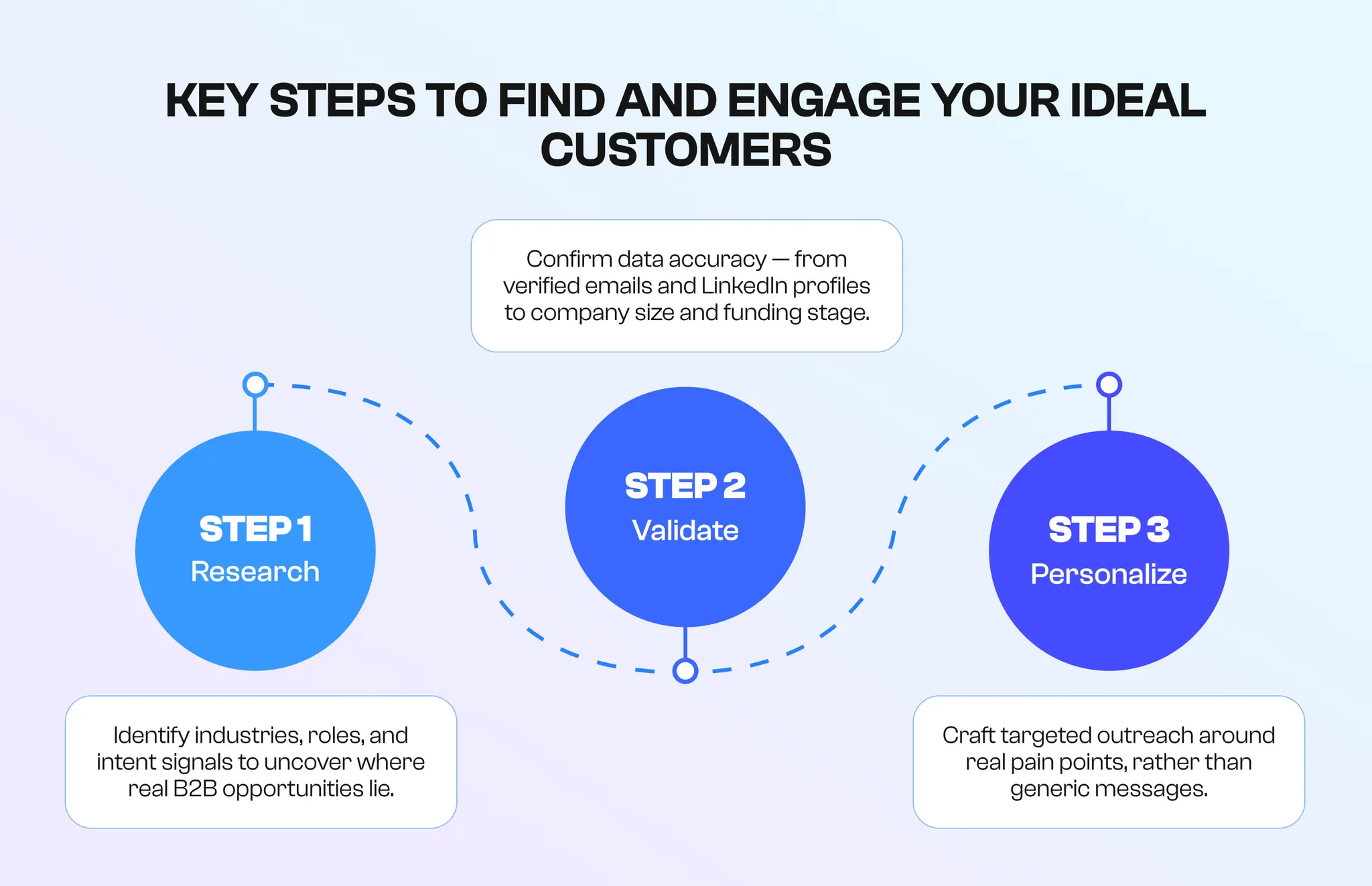
- Researching industries, roles, and intent signals to pinpoint where real opportunities lie.
- Validating data accuracy — from email addresses and LinkedIn profiles to company size and funding stage.
- Crafting personalized outreach that focuses on specific pain points, not generic value propositions.
When you complete all three steps correctly, you move beyond vanity metrics and begin creating meaningful engagement. Across mature B2B campaigns, SalesAR sees an average reply rate between 10% and 18%. That’s the result of clean data, relevant messaging, and a clear understanding of who you’re talking to.
Someone responding to your email might show curiosity, but that doesn’t make them sales-ready. They could be conducting research, comparing vendors, or simply testing the market. Strong lead generation delivers qualified interest, not instant deals. It fills the top of the funnel with people worth pursuing, giving appointment setters a solid foundation to work with.
Signs your lead gen is working:
- You’re getting a steady flow of replies from your ICP, not random job titles or irrelevant industries.
- Your outbound emails consistently achieve a response rate of at least 10%, indicating relevance and high-quality messaging.
- There’s a high match between opened leads and your target market segments, proving your targeting and data sources are aligned.
Effective lead generation services yield conversations with individuals who are genuinely likely to become customers.
What Appointment Setting Adds to the Equation
If lead gen builds awareness and sparks interest, appointment setting turns that interest into interaction. It’s where real opportunities begin to take shape.
Professional appointment setting services aren’t just about scheduling meetings — they convert interest into qualified opportunities. It’s the structured process of qualifying interested leads, confirming their readiness, and securing conversations for your sales team or closers. In other words, it bridges the gap between curiosity and commitment.
Here’s how the process typically looks in a mature outbound workflow, like the one we run at SalesAR:
- Review and score replies. Every response is analyzed for intent — whether it’s genuine interest, mild curiosity, or a polite “not now.”
- Engage in manual qualification. SDRs dig deeper to confirm fit: Does the prospect have a real pain point? A relevant budget? The authority to move forward?
- Book meetings directly to the client’s calendar. Once the lead checks all boxes, a meeting is confirmed with the decision-maker and the client’s sales team.
- Follow up and send reminders. Because a booked meeting means nothing if the prospect doesn’t show up. Consistent reminders help maintain an average show rate of 75–85% across SalesAR clients.
Appointment setting is where automation stops and the human touch starts. No matter how advanced your CRM or outreach software is, you can’t replace the empathy, tone, and adaptability of a skilled SDR.

SalesAR Insight: In B2B SaaS and IT sectors, up to 30% of qualified meetings convert into active sales opportunities. That’s a significant leap from cold outreach to real pipeline growth.
When appointment setting works hand-in-hand with solid lead generation, you’re creating a predictable revenue engine: verified data, personal engagement, and genuine interest back every meeting booked.
Comparing Lead Generation vs. Appointment Setting
One creates motion, the other creates direction. When they run in sync, the result is a healthy, consistent sales pipeline. Here’s a simple breakdown of how they differ and complement each other:
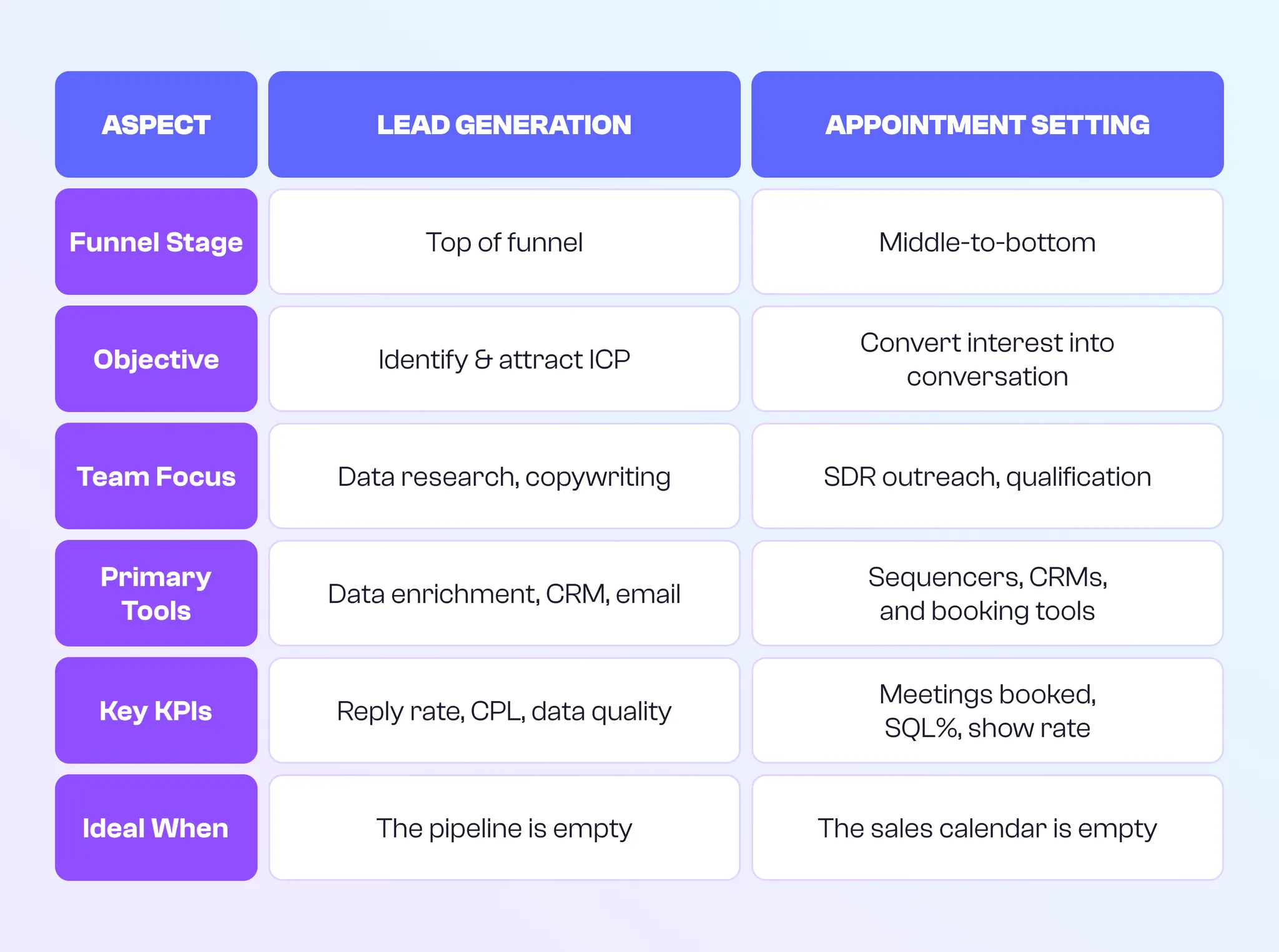
Lead generation identifies and nurtures your target audience, ensuring you have a database of verified, relevant prospects. Appointment setting takes that energy and channels it into motion — reaching out, qualifying, and securing real meetings with decision-makers.
The mistake many teams make is assuming lead generation services can replace the structured process of appointment setting. You can have thousands of validated contacts sitting in your CRM and still see zero meetings if nobody’s taking the next step. Likewise, an appointment-setting team without solid lead gen will spend half its time chasing bad data.
The best-performing sales operations treat B2B lead generation and appointments as parts of a continuous system. One focuses on quality inputs; the other ensures those inputs turn into outcomes. When both functions are aligned, pipeline acceleration happens naturally.
When to Focus on Each
Every company hits different stages in its growth, and the focus depends on where you are in that journey. I’ve seen teams waste months pouring energy into appointments when they didn’t even have a clean database — and others burn cash on list building when they really needed human follow-up.
Let’s look at how the right focus changes by stage:
Case 1 — Early-Stage Startup
A small SaaS company came to us with zero visibility. No database, no contact lists, no real idea of who their buyers were.
We started with B2B lead generation, focusing on building an Ideal Customer Profile, researching decision-makers, and refining their data. Within 30 days, they had a verified prospect list and a 12% reply rate across their first campaign.
Case 2 — Growing SaaS Company
Another client already had leads, but no process to convert interest into meetings. We introduced a dedicated appointment-setting team to handle replies, qualify prospects, and book calls directly into their calendars. In just six weeks, they secured over 70 qualified meetings through a well-structured B2B appointment workflow, transforming a passive database into an active sales pipeline.
Case 3 — Mature Enterprise
For larger clients, the real magic happens when both functions work together. One enterprise company we supported ran dual SalesAR teams: one for continuous lead gen, one for appointment setting. With real-time data sharing and unified reporting, they doubled their pipeline value in a single quarter.
To learn more about how we achieve this, explore our latest case studies and discover what an integrated lead gen and appointment setting system can do for your pipeline.
Warning signs you need lead generation:
- Your CRM is full of outdated or irrelevant contacts.
- Your Total Addressable Market (TAM) isn’t clearly mapped.
- Your outbound emails get fewer than 5% replies.
Warning signs you need appointment setting:
- Your sales team wastes hours chasing unqualified leads.
- Meetings are booked, but they rarely turn into opportunities.
- The calendar looks busy, but the pipeline isn’t moving.
Let’s find out together! Book a call with SalesAR and see how we can help you reach the next growth stage.
Why Integration Beats Isolation
You can have great lead generation or appointment setting services, but when you combine them, the results scale exponentially. At SalesAR, campaigns that integrate both functions see 35–50% higher close rates compared to those that separate them.
Here’s why: both sides thrive on shared data. The same ICP validation that powers precise lead targeting also strengthens qualification later in the funnel. When teams operate under a single system, the entire process becomes faster, smoother, and far more consistent.
In our integrated workflow, everything connects:
- The data team builds and validates leads. They map ICPs, clean data, and ensure contact accuracy before outreach begins.
- Outreach team tests messaging. Copywriters and strategists experiment with tone, personalization, and pain points to identify what prompts a response.
- SDRs follow up, qualify, and schedule meetings. They review replies, assess fit, and move only the right leads forward.
- Feedback loops ensure continuous optimization. Every insight from SDR calls feeds back to the data and outreach teams, refining targeting, content, and approach in real-time.
This alignment eliminates what we call “data leakage” — when valuable leads slip between marketing and sales because of disconnected workflows. Instead of juggling spreadsheets or passing partial lists between departments, every contact remains within a single system until it either converts or exits the funnel with an apparent reason.
In-House vs. Outsourced Execution
We’ve seen companies spend months hiring and training SDRs only to realize that the real challenge isn’t talent, but rather process. The truth is, outreach isn’t just about who’s doing it, but how consistently it’s done.
Let’s look at both sides.
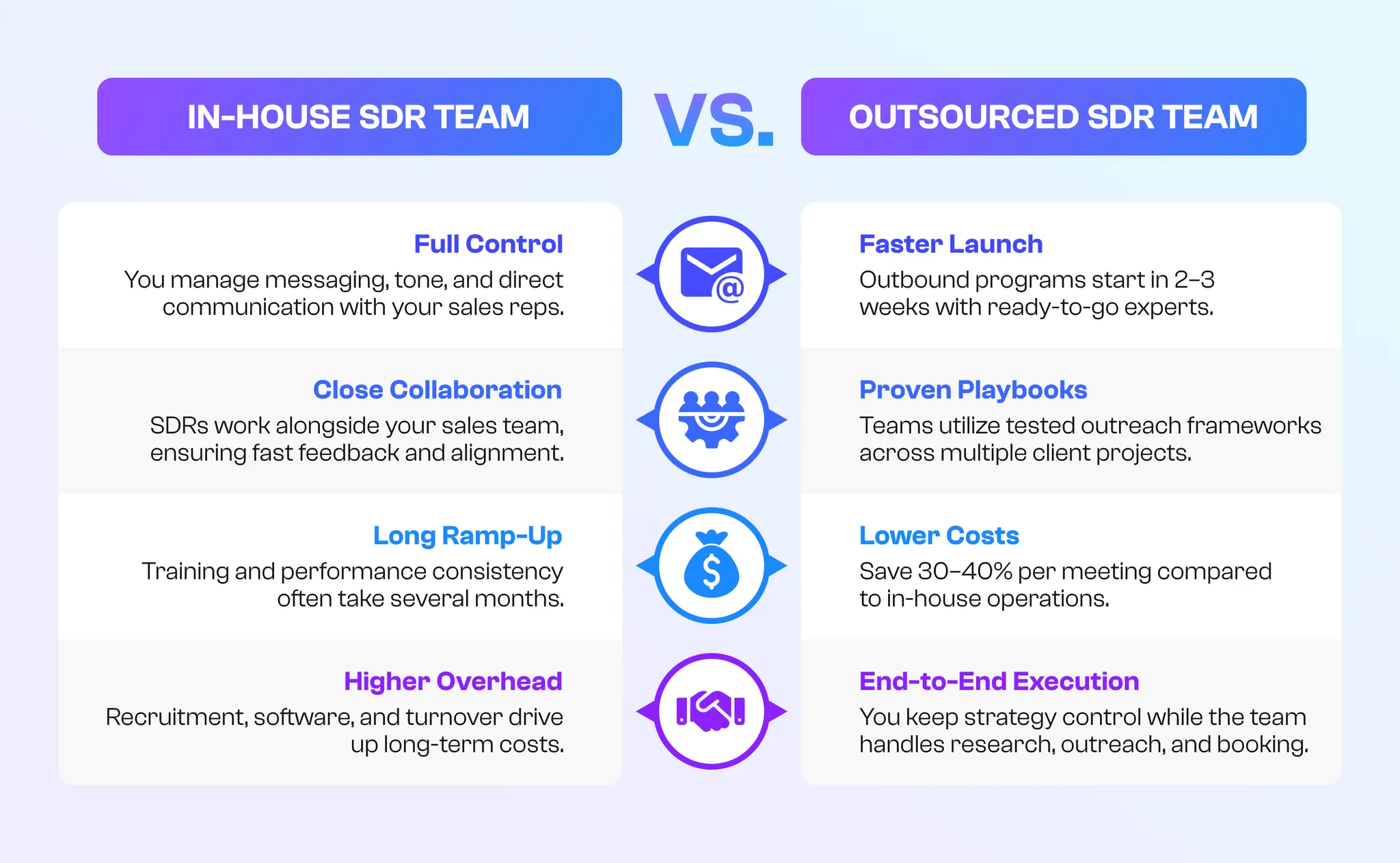
In-house teams possess several clear strengths. You have complete control over messaging, direct access to feedback, and SDRs who live your brand’s tone and culture. They sit close to your sales team, allowing for rapid collaboration. But it’s not without downsides.
Ramp-up takes time — often several months before SDRs perform reliably. Data access can be limited, toolsets are expensive, and high turnover can quickly erase hard-earned progress. Burnout is real when reps juggle research, outreach, and follow-up all at once.
That’s why many companies explore outsourced appointment setting services — not as a shortcut, but as an operational upgrade that boosts efficiency and results.
With SalesAR, outbound programs launch in 2–3 weeks, not months. Teams come pre-equipped with:
- Proven multi-channel playbooks (email, LinkedIn, calling) tested across 800+ projects.
- Dedicated researchers, SDRs, and strategists aligned to your ICP and sales goals.
- Continuous reporting and dashboard visibility so you always know what’s happening and why.
SalesAR Insight: Outsourcing SDR operations can reduce the cost per meeting by 30–40% compared to in-house setups. That’s because you’re paying for outcomes, not overhead — no recruitment costs, no software stacking, no idle hours.
The biggest misconception? That outsourcing means giving up control. In practice, it’s the opposite. You keep ownership of strategy and pipeline, while the delivery team handles execution, optimization, and scale.
The best setup often blends both worlds: your in-house team for relationship-building and deal closing, and an outsourced SDR team to keep the pipeline constantly moving.
Conclusion
When your data, messaging, and SDRs work in sync, every stage of the funnel supports the next. Awareness turns into interest, interest turns into conversations, and conversations turn into deals.
If your pipeline feels stuck, assess whether your B2B appointment strategy or your lead generation needs more attention. Are you struggling to reach the right people — or struggling to turn replies into meetings? The answer will indicate which part of your process requires the most attention.
Book a call with SalesAR and see how our lead generation and appointment setting experts can accelerate your B2B pipeline.
FAQ
What is the main difference between appointment setting and lead generation?
Lead gen focuses on identifying and engaging potential customers who fit your Ideal Customer Profile. Appointment setting takes those engaged leads and converts them into booked meetings through qualification and direct communication.
Which service is better for B2B companies: lead generation or appointment setting?
Neither is “better” — they serve different roles. Lead gen fills the top of your funnel with interested prospects, while appointment services move them down the funnel into actual sales conversations. For most B2B companies, the best results are achieved by combining both.
Can a company use both lead generation and appointment setting together?
When both processes are integrated, you minimize lead drop-off, accelerate conversions, and build a more predictable sales pipeline. SalesAR campaigns that combine both functions often achieve 35–50% higher close rates.
How do I decide whether to invest in lead gen or appointment setting?
Look at your bottleneck. If your CRM is empty or outdated, begin by generating leads to establish a clean pipeline. If you already have leads but few booked meetings, appointment setting will create traction. Many companies start with one and scale to both for maximum ROI.