










A few months ago, I reviewed a campaign that initially appeared promising: an inbox full, a high reply rate, and everything green in the dashboard. But once I went through the conversations, it hit me — almost none of the replies came from people who could buy. Plenty of noise, nearly zero real opportunities.
Have you ever had that moment when you realize the problem isn’t the outreach effort, but the kind of lead you’re talking to in the first place?
That’s the challenge many companies face. Buyers are harder to reach, and even harder to qualify. They jump across 7–10 channels before making a decision, and they ignore anything that feels irrelevant.
Building Better Business Leads Through ICP & Intent Signals
Before discussing channels, tools, or clever outreach tactics, let me share something that has changed the way my team works.
We once had a client who came to us frustrated: “We’ve tried everything. No one replies.”
However, when we examined their ICP, it was… let’s call it optimistic. They were targeting every company that might need them, across industries with no commonalities, and job titles that didn’t even belong in the same buying process.
We tightened the ICP, cut out 40% of their original audience, and properly segmented the rest. Within two weeks, reply quality shot up, and their meeting rate nearly doubled. The same outreach team, the same messaging, and the same offer. The only change? Talking to the right people. This is where lead quality truly begins.
What an ICP Really Is in 2025
When I discuss ICP today, I don’t mean a paragraph in a Google Doc stating, “mid-market companies, tech, North America.” A real ICP in 2025 is a living blueprint. It evolves with the data you collect, the wins you close, and the losses you analyze. It’s built on specifics, not assumptions.
So what does that look like?
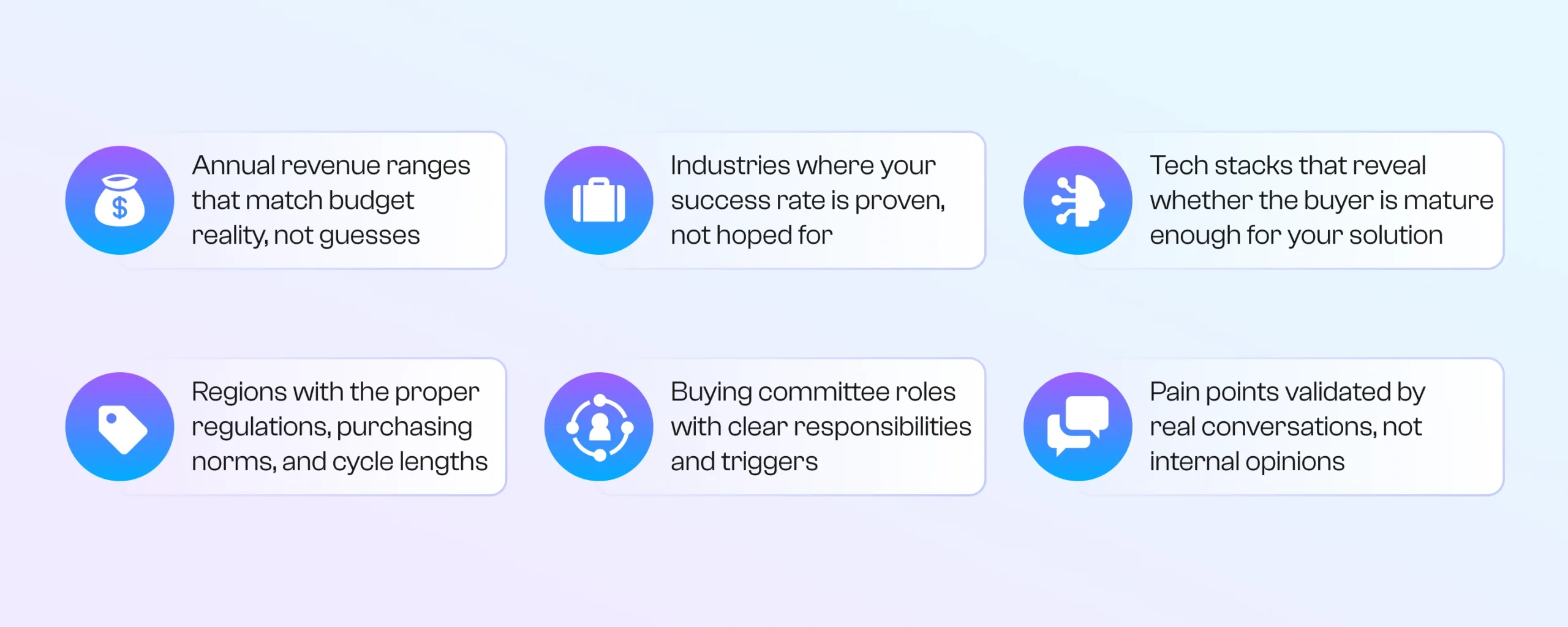
When clients tell me “everyone can use our product,” I already know the campaign will struggle. The companies that win in 2025 are those that treat their ICP as a strategic asset, not a checkbox.
Segmentation: The Part Everyone Skips
Once the ICP is documented, segmentation is where the absolute precision begins.
This is where we ask questions like:
- Who has the right budget?
- Who feels the pain most urgently?
- Who has the internal processes in place to act quickly?
- Who already uses tools that integrate with yours?
- Who are the true decision-makers, influencers, and blockers?
At SalesAR, we break segments down by:
- Revenue tiers — because a $5M company and a $200M company buy differently
- Tech stack — CRMs, automation tools, platforms, or integrations
- Hiring patterns — a company adding SDRs or engineers sends buying signals
- Geography — compliance, culture, and procurement habits all matter
- Buying committee roles — VP Sales sees one problem, RevOps sees another
This is the difference between outreach that feels generic and outreach that consistently brings in the right leads for business.
How We Use Intent Data Before Outreach Even Starts
Most teams treat intent data as an add-on to their existing marketing efforts. We treat it as step zero. Before a single email is written, we scan for signals using lead generation tools that help us understand which companies are actively researching solutions.
- Companies searching for relevant keywords
- Accounts growing traffic on pricing or integration pages
- Firms are consuming content around their specific business challenges
- Tech installations or removals
- New job openings (a massive buying trigger)
When someone is already in “research mode,” your message aligns with where they already are.
The quality of each lead starts with where you look. Some channels attract people who are simply browsing, while others draw those who are already seeking a solution. And if there’s one thing I’ve learned from running hundreds of campaigns at SalesAR, it’s this: the channel you choose determines the intent you get.
Book a free consultation with SalesAR and discover how our team combines data, automation, and human touch to fill your calendar with qualified meetings.
How SEO Helps You Capture the Highest-Intent Business Leads
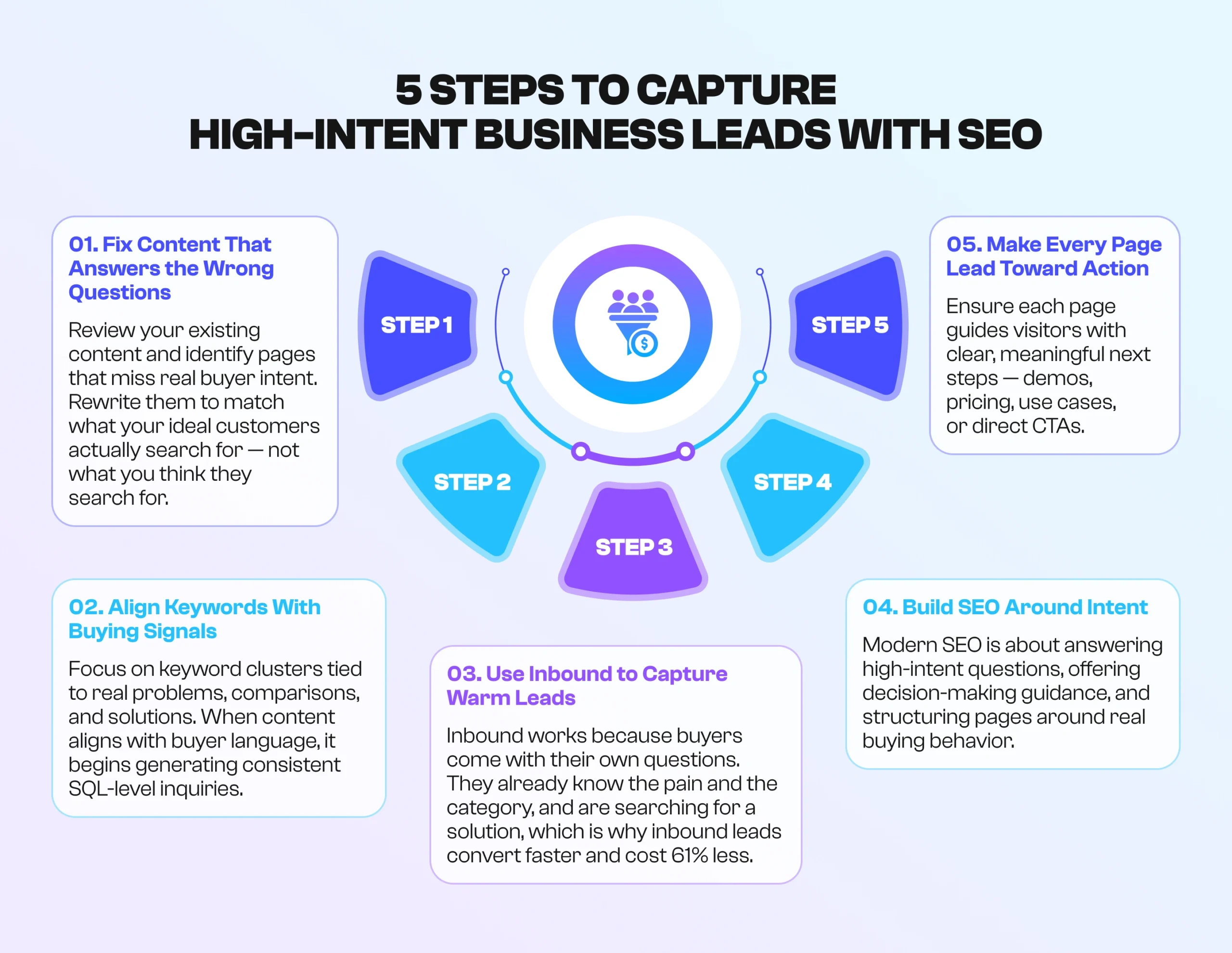
A while back, we had a client whose inbound pipeline was nearly empty. They were investing most of their time in outbound efforts, which were performing well, but their inbound efforts were barely producing any results. When we reviewed their content, we found a long-form guide that had potential but was answering the wrong question — a question their buyers rarely asked.
We rewrote it. The exact structure and keyword cluster, but this time, the guide matched what real buyers were actually searching for. Within a month, the page started generating consistent SQL-level inquiries.
That’s the power of intent-based traffic — it naturally attracts leads for businesses who are already searching for a solution.
Why Inbound Produces Such High-Quality Leads
Inbound leads start with their question, not your pitch. When someone types a problem into Google, they’re not passively browsing; they’re actively looking for answers, options, and solutions.
This changes the entire dynamic:
- They already feel the pain point
- They already know the category
- They already want a fix
- They’re usually in the mid-to-late stage of the buying journey

SalesAR Insight: Inbound costs 61% less than outbound and produces higher-quality leads. And from our experience at SalesAR, inbound leads often close faster because the buyer is already warmed up before they even talk to you.
SEO in 2025: Still Powerful, But With New Rules
SEO used to be about stuffing keywords and ranking for generic terms. In 2025, it’s completely different.
Here’s what matters now:
- Content that directly answers specific, high-intent questions
- Pages built around search intent, not vanity topics
- Mixed formats: guides, templates, funnels, comparison pages
- Topic clusters built around real buying triggers
- Clear next steps (CTAs, demos, pricing, use cases)
If your content helps buyers make a decision, Google rewards you. If you’re not visible there, someone else gets the conversation first.
Google Ads: The Fast Track to High Intent
While SEO builds long-term authority, Google Ads allows you to capture demand instantly.
Think about it. If someone searches:
- “best SOC 2 compliance platform”
- “top B2B appointment setting agencies”
- “lead gen for IT companies”
…you already know what they want. Matching that intent with precise keyword targeting, optimized landing pages, and strong offers can create consistent revenue without waiting months for organic rankings.
We often pair SEO + Google Ads for clients because the combination balances both sides:
- SEO = long-term compounding authority
- Google Ads = immediate high-intent traffic
- Together = maximum coverage of the buyer journey
Going all in on only one channel leaves gaps. Running both fills them.
What You Should Do Right Now
Here’s what I recommend to any company looking to improve lead quality through Google:
- Review your top 5 pages. Do they answer real buyer questions? Or are they “content for the sake of content”?
- Identify 5–10 high-intent keywords. These keywords usually include words like: “platform,” “software,” “agency,” “services,” “solutions,” “compare,” “best,” “pricing.”
- Align your SEO content with your PPC campaigns. We’ve seen ad performance improve simply because the organic pages supported the same topics.
- Add clear CTAs everywhere. Buyers shouldn’t have to hunt for a way to contact you.
Cold Outreach: Still One of the Fastest Paths
I’ve heard so many people say “cold outreach is dead” that sometimes I wonder if we’re talking about the same thing. At SalesAR, we see cold outreach generate meetings with VPs, founders, CTOs, and procurement leads — individuals who would likely not have discovered the client on their own.
Cold outreach isn’t dying. Bad cold outreach is dying. For companies seeking to generate consistent small business leads, precision targeting is even more crucial.
Let me give you a quick example. We once ran a campaign for a cybersecurity company entering a new market. They didn’t have brand awareness there; they had no inbound presence, nothing at all. We began with clean targeting, personalized angles, and a message tailored to the buyer’s specific risk. Within three weeks, they booked meetings with CISOs at companies with which we had no prior connection.
Why Cold Outreach Still Delivers High-Quality Leads
Cold outreach gives you something other channels can’t: precision in choosing exactly which lead you want to start a conversation with. You decide exactly who you want to talk to and when. You aren’t waiting for algorithms, search trends, or inbound flows. You’re proactively starting conversations with ideal buyers.
Here’s what makes it so effective when done right:
- You can target decision-makers directly, rather than relying on them to discover you.
- You can enter new markets instantly, without warming up audiences first.
- You can test offers, value props, and ICP segments faster than any other channel.
- You can scale consistently — outreach doesn’t depend on platform volatility.
When your targeting is accurate and your message is relevant, cold outreach feels less like a pitch and more like a helpful nudge.
The Cold Outreach Formula That Works in 2025
Over the years, we’ve refined cold outreach to a few fundamentals that consistently bring results:
- Talk about them, not you. Prospects don’t want your biography. They want clarity about how you solve their specific problem.
- Keep it short. Long messages die in crowded inboxes. Clear, concise, value-focused lines win.
- Personalization beyond “{{first_name}}.” Mention a hiring trend, a technology they use, or a market shift affecting their industry.
- Multi-channel beats single-channel. Email + LinkedIn + phone + follow-up sequences = drastically higher response rates.
- Offer a small win, not a big ask. A quick audit, a short workflow review, a tailored insight. Small steps open big doors.
When you match your outreach to the buyer’s world, the conversation doesn’t feel “cold.” When paired with a clear ICP, strong segmentation, and real personalization, it becomes one of the fastest and most predictable ways to create new revenue.
Book your consultation with SalesAR and discover how our team turns targeted outreach into qualified, sales-ready conversations that grow your pipeline fast.
LinkedIn: Channel for Decision-Makers
A few months ago, we ran a campaign where the client insisted we focus heavily on InMails. Fair enough — everyone loves the idea of direct outreach. But what surprised them was where the real results came from: comments.
Not long messages. Not polished templates. Just thoughtful, relevant comments on posts from people inside their ICP. Those comments led to profile views, which in turn led to connection requests, which ultimately resulted in conversations — and eventually several SQLs. It was a good reminder that on LinkedIn, trust always beats volume.
Sales Navigator Filters That Actually Matter
Most people overcomplicate Sales Navigator. In reality, there are only a handful of filters that consistently improve lead quality:
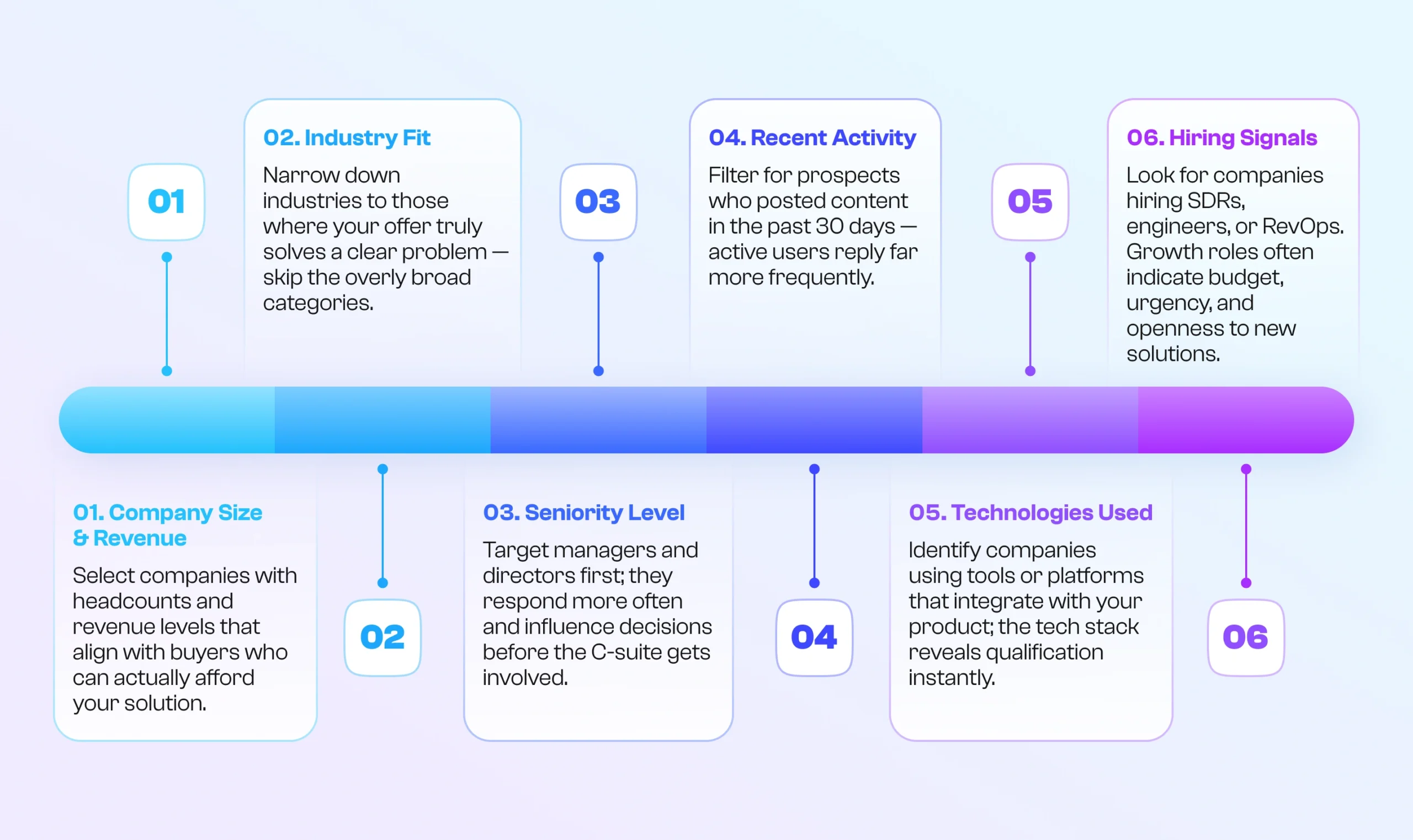
- Company size and revenue range: Helps you focus on organizations that realistically have the budget and resources to buy.
- Industry selection: Narrow your search to industries where your offer is relevant, instead of relying on broad or unfocused categories.
- Seniority level: Target managers and directors first — they respond more often and typically influence the buying process before it reaches the C-suite.
- Recent activity: Prioritize prospects who have posted or engaged within the last 30 days; active users are significantly more likely to reply.
- Technology stack: Filtering by tools and platforms the company already uses is one of the fastest ways to qualify accounts.
- Hiring signals: Pay attention to companies hiring SDRs, engineers, or RevOps roles — growth-oriented teams usually have budget, urgency, and openness to new solutions.
Webinars, Trainings & Virtual Events
A while ago, we helped a SaaS client launch a brief educational webinar — just 35 minutes, no frills. No celebrity speakers. No overproduced studio setup. Just a clear topic, a strong hook, and practical examples. For the next four weeks, their sales team had a steady stream of SQLs coming in from that single session. That’s the kind of channel webinars can be when they’re done with intention, not theatrics.
Why Webinars Still Work in 2025
You might think webinars are old-school, overused, or irrelevant for generating small business leads, but in reality, the format still performs exceptionally well when done right.
SalesAR Insight: 53% of B2B buyers say webinars are the most valuable content format, and a well-structured session can turn a curious attendee into a qualified B2B lead in under an hour.
Webinars filter out the people who care. If someone gives you 30 minutes of their day in a world full of endless content, they’re actively evaluating solutions.
The Anatomy of a Webinar That Converts
After running dozens of successful event funnels, here’s the structure I always come back to:
- Start with a problem, not a product. If the first ten minutes sound like a sales demo, you lose half the room. Open with the challenge the audience deals with daily.
- Show real examples. People want to see screenshots, numbers, processes, or results they can copy.
- Keep the content tight. High-performing webinars rarely exceed 40 minutes. Shorter = higher attendance + higher retention.
- Plan the CTA from the start. The CTA doesn’t have to be aggressive. Sometimes “Grab the checklist” or “Download the template” opens more doors than “Book a demo.”
- Follow up within 24 hours. The difference between a good webinar and a high-conversion webinar is follow-up. Every hour that passes lowers intent.
Repurposing: Where the Real Scale Happens
A single webinar can fuel an entire month’s worth of content if you know how to break it down. Here’s how we typically repurpose:
- Short clips for LinkedIn (10–40 seconds)
- Mini-lessons for email nurturing
- Slide screenshots turned into carousels
- A summarized blog post for SEO
- A downloadable checklist or playbook
- A nurture sequence for registrants who didn’t attend
- Retargeting ads using the strongest clips
Webinars do something that email, ads, and cold outreach struggle to replicate: they give prospects a chance to experience your expertise. People remember how you made them think, not just what you said. And by the time they reach your sales team, they come pre-qualified, warmed up, and familiar with your framework. That’s why this format continues to outperform. And in 2025, as buyers demand substance over slogans, webinars will continue to be one of the most efficient ways to turn attention into revenue.
Review Platforms (Clutch, G2, UpCity)
We once worked with a client who hadn’t touched review platforms for years: no Clutch profile, no G2 presence, and barely any public feedback. After a bit of convincing, they started gathering reviews consistently — one per week at first, then a few per month. Within a quarter, something interesting happened: inbound leads started appearing with messages like “We found you on G2” or “Your Clutch reviews convinced us to reach out.”
Nothing else in their marketing changed. Just the reviews. That’s how powerful these platforms are when you treat them with care — they often deliver some of the warmest business opportunity leads long before a prospect ever fills out a form.
How to Collect Reviews Ethically
You don’t need incentives, gimmicks, or pressure tactics. The most effective approach is simple:
- Ask shortly after a win — when the client is happiest.
- Make the process easy — send the direct review link.
- Offer structure — provide 3–4 prompts to help them write.
- Thank them personally — a small gesture goes a long way.
When done right, reviews create a predictable stream of inbound leads that already trust you before the first call. In 2025, that kind of trust is a shortcut you can’t afford to skip.
Lead Scoring: Turning Attention Into Prioritization
A strong scoring model enables sales teams to focus on identifying who is most likely to convert. The most effective models combine fit, engagement, and timing. Fit evaluates whether a lead matches your ICP. Engagement reflects how actively the lead interacts with your content, website, or emails. Timing is based on external signals, such as hiring activity, funding announcements, or technology changes.
Before you even score anything, your business leads list needs to reflect your ICP; after that, a simple scoring structure often includes:
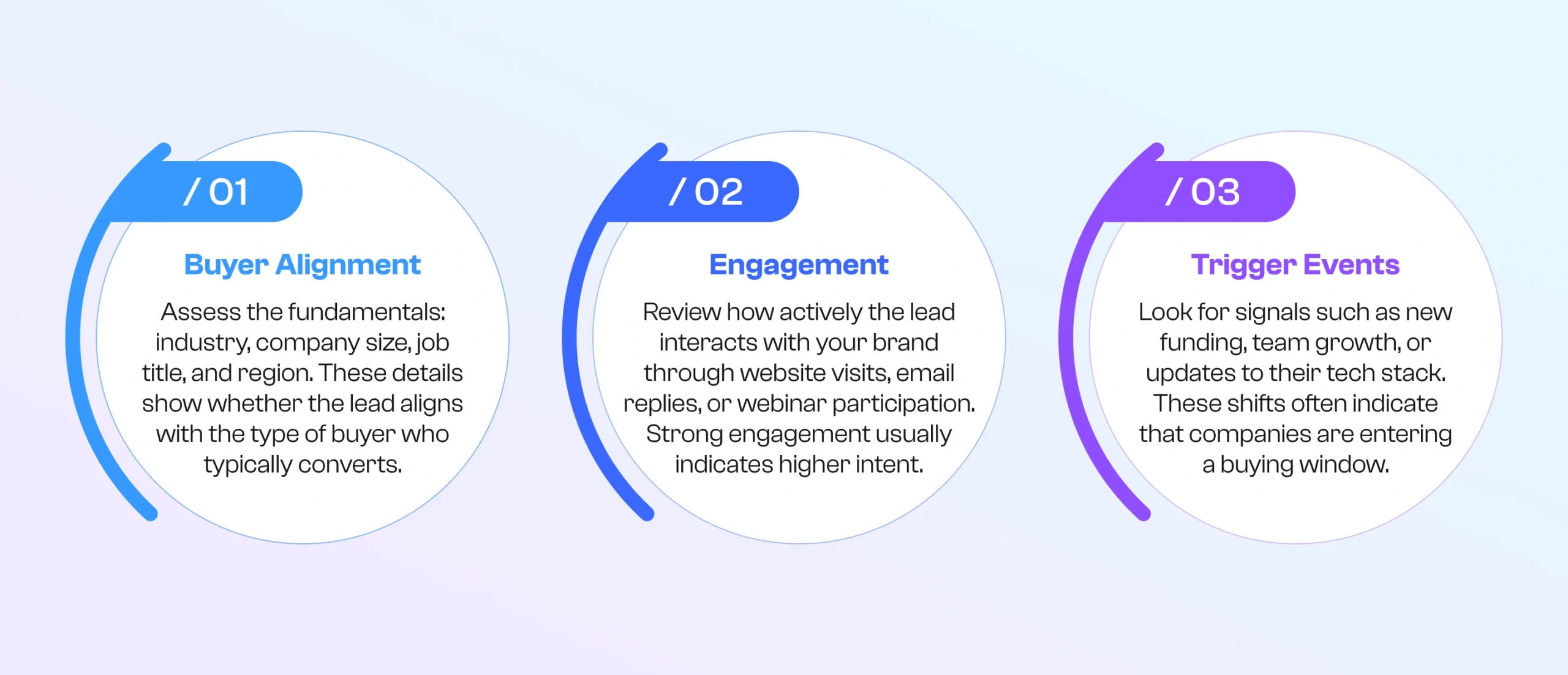
- Buyer Alignment: Look at the basics — industry, company size, job title, and region. These factors indicate whether the lead aligns with the type of buyer who is most likely to convert.
- Engagement: Measure the level of interaction between the lead and your brand through website visits, email responses, or webinar attendance. High engagement usually signals higher intent.
- Trigger Events: Monitor indicators such as new funding, team expansion, or recent changes to the technology stack. These shifts often reveal a company that’s entering a buying window.
When these layers work together, your business leads list becomes clearer, the pipeline becomes cleaner, and prioritization becomes easier.
Marketing + Sales Alignment: Where Predictability Starts
Pipeline reliability depends on how well marketing and sales operate as a single unit. When both teams share a single ICP, a unified definition of lead stages, and a standard scoring model, performance becomes far more consistent. Follow-ups occur on time, messaging aligns with expectations, and both teams evaluate results using the same criteria.
SalesAR Insight: Companies with strong marketing and sales alignment grow 19% faster, largely because their pipelines are cleaner, faster, and easier to forecast.
Conclusion
The most significant shift happening in 2025 is simple: volume no longer wins. Quality does. When targeting becomes sharper, messaging becomes more relevant, and timing aligns with genuine intent, every channel works more effectively — including outreach, SEO, ads, webinars, and social content.
Companies that grow fastest now are the ones that deeply understand their buyers: how they research, what they care about, which signals show true intent, and how to design lead generation strategies around that reality. Tools matter, but they matter only when used with precision.
Lead quality strengthens conversion rates, forecasting, and revenue consistency. Lead quantity only fills databases. The advantage belongs to teams that prioritize relevance over reach, clarity over volume, and meaningful conversations over mass outreach. The strategy is quality. The channels are just execution.
FAQ
What is the best way to generate quality business leads?
The strongest approach is to start with a clear ICP and target only the segments that match your ideal buyer profile. Utilize intent-driven channels, such as Google, LinkedIn, and review platforms, and pair inbound content with targeted outbound outreach. When relevance is high, lead quality naturally increases.
How can small businesses find new leads without a big budget?
Small businesses can rely on educational content, organic search, and social channels to attract early interest. Publishing valuable insights on LinkedIn, YouTube, or TikTok is often enough to generate inbound conversations. Free tools like Google Search Console or LinkedIn search help identify prospects, and small, highly targeted outreach campaigns can be effective even with minimal spending.
What role does LinkedIn play in finding business leads?
LinkedIn remains the most direct way to reach decision-makers. It helps build trust through consistent posting, comments, and thought-leadership content. Sales Navigator makes it easier to target people who match your ICP, and many buyers prefer engaging on LinkedIn before responding to email or booking a call.
How can I ensure my leads are of high quality?
High-quality leads come from a defined ICP, a clear scoring system, and strong intent signals. Regularly update your ICP based on closed deals, evaluate how prospects engage with your content, and track key buying triggers, such as hiring, funding, or technology changes. Clean CRM data ensures your team can prioritize the right opportunities without guessing.
No cold outreach, no stress. Just sales-ready calls with decision-makers.