








In B2B sales, the primary challenge is securing qualified meetings. You can have thousands of contacts in your CRM, but if your calendar stays empty, none of that effort matters.
Buyers are more selective than ever. They ignore generic outreach and tune out spammy automation. What works now is a structured, strategic approach to appointment setting — one that turns outreach into genuine conversations with the right people.
This guide shows how to make that shift: from chasing volume to booking meaningful, high-converting meetings. Modern appointment setting in B2B sales emphasizes precision, timing, and personalization, rather than just the volume of outreach.
- From Quantity to Quality
- Master ICP and Buyer Persona Alignment
- Build a Message That Gets a Yes
- Choose the Right Channels and Timing
- Automate, but Don’t Dehumanize
- Handle Objections Before They Arise
- Follow-Up Like a Pro
- Measure, Improve, Repeat
- Creative Ways to Boost Meeting Bookings
- Conclusion
- FAQ
From Quantity to Quality
If your goal is still “make 20 calls a day,” it’s time to rethink your strategy. Activity doesn’t equal impact anymore. The modern sales process rewards precision. The key is focusing on qualified intent and specific targeting. Define your ideal customer profile (ICP) and set SMART goals: specific, measurable, achievable, relevant, time-bound.
For example: “Book 10 meetings this month with procurement directors at SaaS companies generating $5–20M ARR.”
This level of clarity keeps you focused on prospects who fit your product, message, and growth stage.
According to SalesRoads, teams that clearly define their ICP and use qualification-based outreach in sales appointment setting see up to 34% higher conversion rates from meetings to opportunities. HubSpot data shows that companies using targeted prospect lists experience a 46% higher reply rate than those using generic databases.

SalesAR Insight: At SalesAR, we’ve seen this firsthand: campaigns that narrow their focus to specific segments (industry, company size, role) deliver 2–3 times more sales-qualified appointments than broad, untargeted outreach.
The takeaway is simple: don’t chase numbers, but alignment — because effective appointment setting depends on targeting the right buyers, not contacting more of them. When every lead matches your ICP and your message speaks to their needs, meetings become a predictable outcome.
Master ICP and Buyer Persona Alignment
You can’t book quality meetings if you don’t know who you’re talking to. Most outreach efforts fail because they target too broadly — or worse, assume that every decision-maker in a company shares the same interests. That’s where ICP (Ideal Customer Profile) and buyer persona alignment play a crucial role.
Think of your ICP as the company fit, and your buyer persona as the human fit. When both align, conversations flow naturally because your message hits the right pain points, in the right tone, at the right time.
Effective segmentation breaks into four layers:
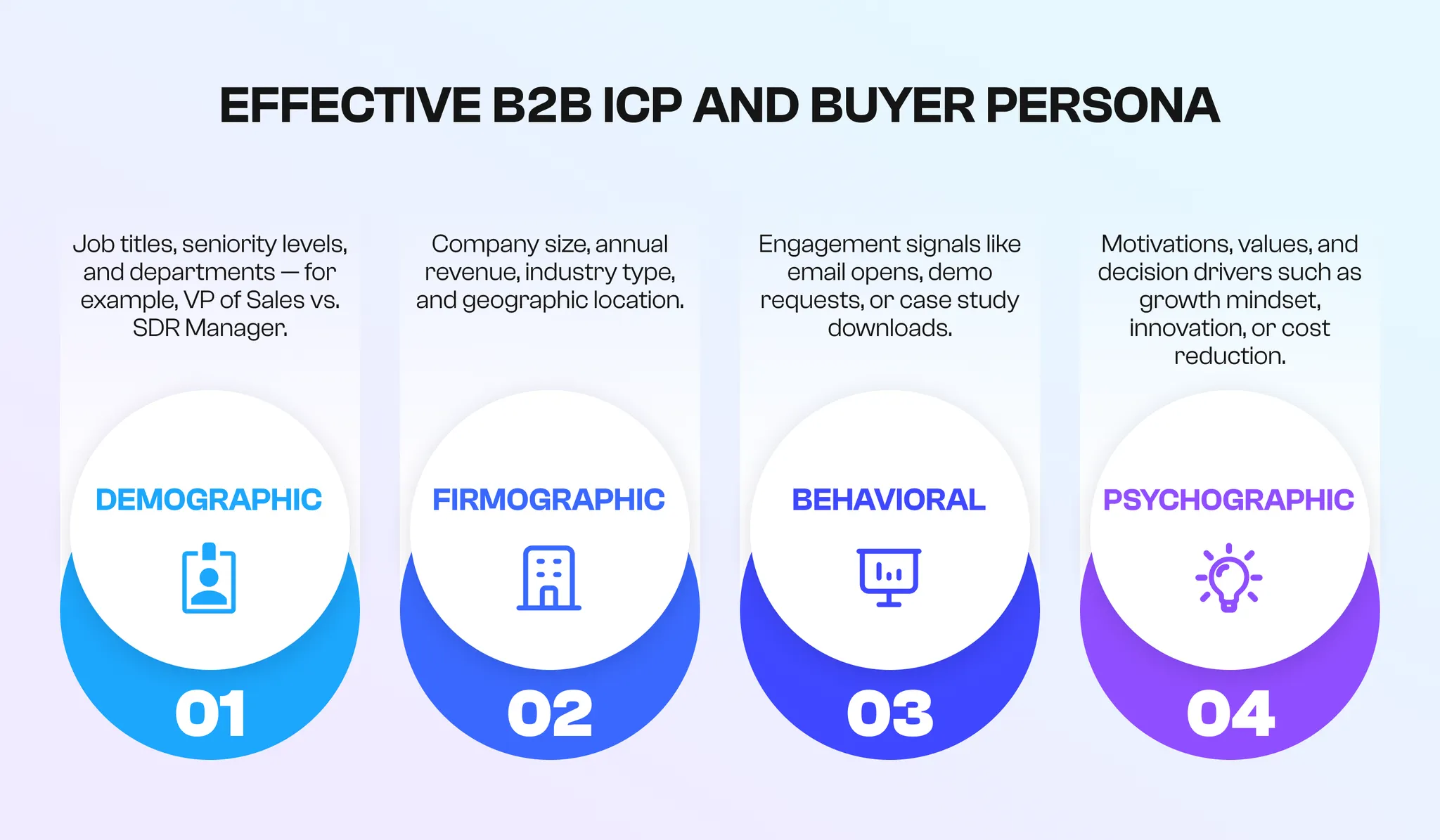
- Demographic: job titles, seniority level, department (e.g., VP of Sales vs. SDR Manager).
- Firmographic: company size, revenue, location, and industry.
- Behavioral: engagement patterns — email opens, demo requests, case study downloads.
- Psychographic: motivations, values, and decision triggers (growth mindset, cost reduction, innovation).
Once you’ve mapped this out, add behavioral signals into your lead scoring — one of the most overlooked stages in appointment setting strategy. Tracking intent data, such as time spent on your site or specific page visits, can increase meeting conversion rates by up to 40%.
Let’s say your product is a B2B SaaS platform. If a prospect spends 5+ minutes on your pricing page, downloads your case study, and opens two outreach emails — that’s a hot signal. Reps should reach out immediately while interest is high. Tools like HubSpot, Apollo, or Clay can automatically track and rank these actions, giving your appointment setting process a smarter, data-backed rhythm.

SalesAR Insight: Review your last three closed-won deals. Who converted fastest? Look for commonalities in their initial responses. You’ll often find patterns that refine your targeting better than any template or script.
When your ICP and persona work together, you stop pitching blindly and start having real, relevant conversations. That’s where your calendar finally starts filling up with meetings that matter.
Build a Message That Gets a Yes
Most cold outreach fails before the first line. It’s because the message sounds like everyone else’s. Generic intros, rushed CTAs, and zero personalization just get ignored. To win more meetings, you need to sound like a person who understands the prospect’s world, not a template trying to sell into it.
Start by doing what most reps skip: research. Practical outbound appointment setting begins with context: knowing your prospect’s market, competitors, and pain points. Scan their recent LinkedIn posts, website updates, or funding announcements to stay informed if they just hired new SDRs, and mention how your solution could shorten onboarding time. Relevance turns a cold email into a conversation starter.
Next, ask open-ended questions instead of pitching features. Discovery-style outreach, which invites dialogue (“How are you currently handling X?”), outperforms one-sided value statements by 27% in terms of reply rates.
Here’s what that looks like in practice:
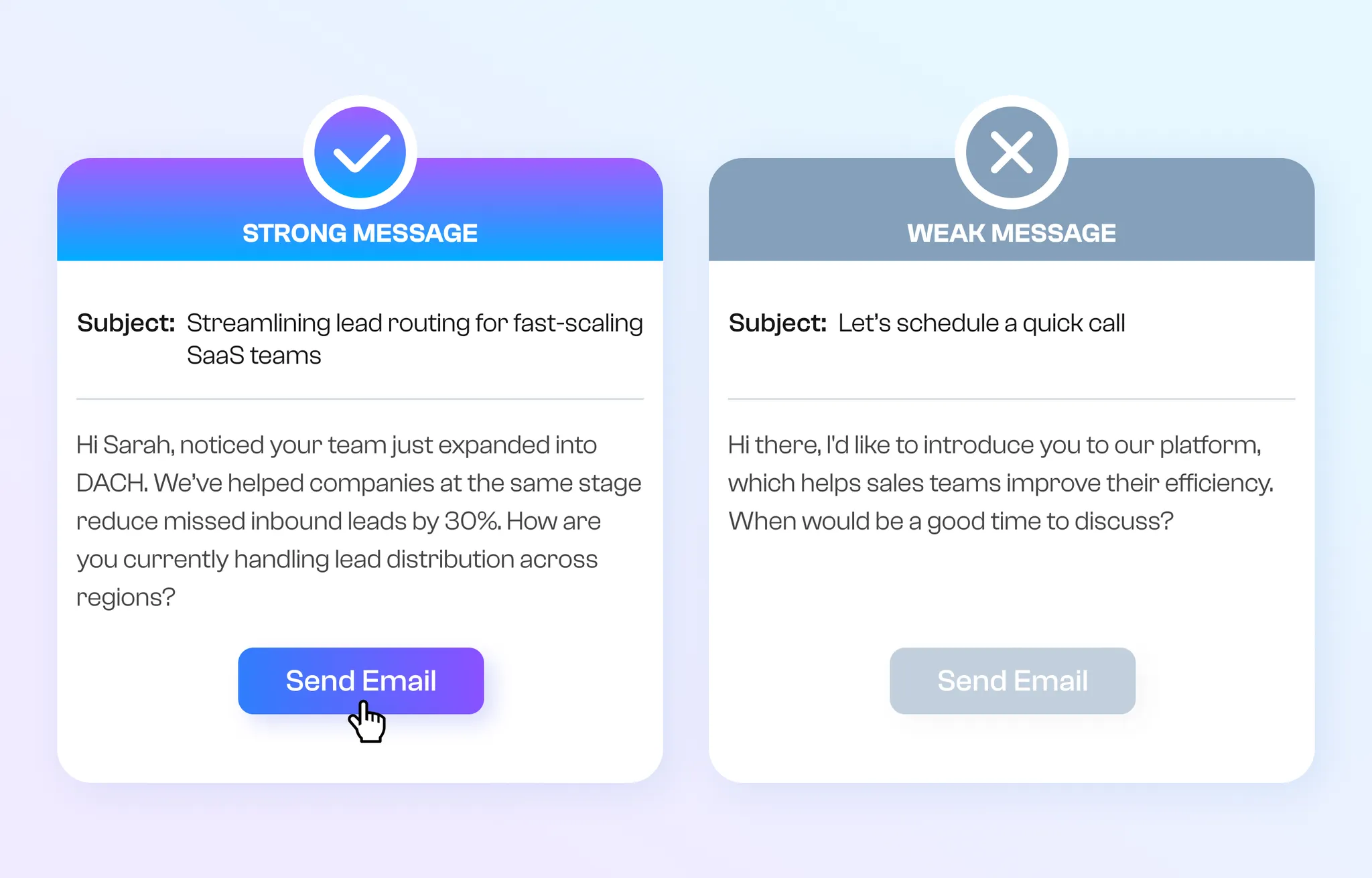
The first message shows effort and relevance. The second feels robotic.
SalesAR Insight: In EU markets, softer CTAs consistently win. Prospects respond better to low-pressure phrasing rather than direct requests. It fosters trust and respects their autonomy, which leads to more genuine meetings in the future.
When your message feels human, informed, and conversational, you’re earning a meeting. And that’s the real difference between outreach that annoys and outreach that converts.
Choose the Right Channels and Timing
The best appointment setting strategies build an ecosystem around prospects using coordinated email, LinkedIn, and phone outreach. Email, LinkedIn, and phone calls aren’t competing tools; they’re parts of the same sequence. When used together, they reinforce your message, build familiarity, and increase the odds of getting a “yes.” This approach is practical when you understand how to generate high-quality leads through LinkedIn engagement and outreach.
Omnichannel outreach outperforms single-channel efforts by as much as 47% higher meeting rates. A prospect might ignore your email but recognize your name later — that multi-channel familiarity is what modern sales appointment setting relies on.
Timing matters just as much as the medium. Calling prospects “when their inbox is quiet” — typically between 8:00–9:00 a.m. or 4:00–5:30 p.m. in their local time zone — can lift connection rates by nearly 35%. Late-afternoon outreach often catches decision-makers between meetings, when they’re more open to a short chat.
Here’s how to structure your outreach rhythm effectively:
- Email → Build awareness. Start with a short, relevant message introducing your value and asking an open-ended question. Keep it under 100 words.
- LinkedIn → Establish credibility. Send a connection request with a personal note, engage with their posts, or share insights they’ll find helpful. Don’t pitch immediately — build context first.
- Phone → Close the appointment. Once you’ve built recognition, make the call. As a follow-up to your earlier outreach (“I sent you a quick note last week about X”), please keep it natural.
The best reps track engagement across channels. If someone opens your email three times or views your profile on LinkedIn, that’s your cue to call. Outreach is about being present at the right time, in the right place, with the right message. Knowing which lead generation channels bring the strongest response helps make every touchpoint count.
Automate, but Don’t Dehumanize
Automation is both the best friend and biggest trap of modern appointment setting. The right tools can save hours a day, but if you hand the entire process over to bots, you’ll lose the very thing that books meetings: human connection.
Blend automation with personalization through an integrated tool stack — CRM syncs, scheduling tools like Calendly, and outreach platforms such as HubSpot or Apollo. These tools streamline logistics while maintaining a human touch in communication.
Automation should handle the volume, not the voice — that’s how outbound appointment setting stays authentic while scaling efficiently. Let it schedule, track, and follow up — but keep the final touch personal. That’s what separates a machine-generated sequence from a genuine conversation.
Here’s a simple, balanced workflow:
- Outreach: Use your CRM to launch segmented email campaigns targeting specific ICPs. Personalize the opening line using dynamic fields (company name, role, pain point).
- Automated follow-up: Set a gentle follow-up cadence over 7–10 days. Use automation to remind, not to spam.
- Personalized check-in: When a lead clicks, replies, or visits your website — jump in manually. Reference their action (“I noticed you checked our case study on SaaS integrations. Are there any specific challenges you’re exploring?”).
This hybrid model maintains consistent and scalable outreach while preserving authenticity. At SalesAR, this balance enables reps to send hundreds of messages a week without sounding like robots. The key is to let software do the heavy lifting — but let you do the talking.
Book a free consultation with SalesAR and discover how our team combines data, automation, and human touch to fill your calendar with qualified meetings.
Handle Objections Before They Arise
The best appointment setting professionals disarm objections before they happen — not by pushing harder, but by communicating smarter. Buyers expect resistance (“We don’t have time,” “No budget,” “Send me info”), and your job isn’t to bulldoze through it. It’s to show confidence without pressure.
Use softening language like “but you’re free to choose…” to reduce defensiveness while maintaining authority.
For example: “I understand timing’s tough, but you’re free to choose whether a 15-minute chat fits this week or next. Either way, I’ll make sure it’s valuable.”
It shifts the tone from pushy to collaborative, giving control back to the buyer while maintaining an open door.
Here’s a quick reference table for common objections and effective counters:
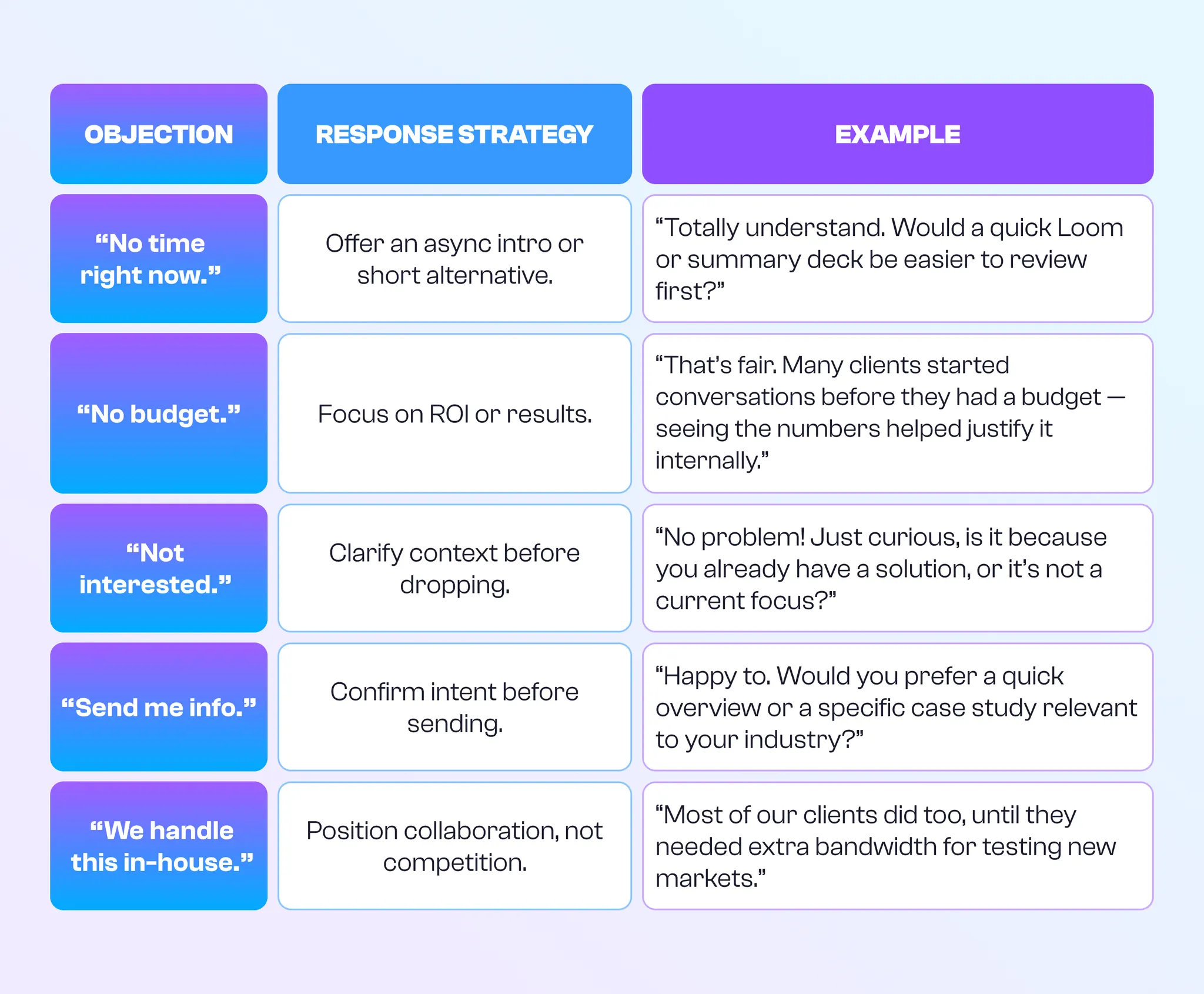
Proactive empathy is the foundation of sustainable appointment setting, turning rejections into postponed opportunities. According to HubSpot’s Sales Trends Report, 63% of buyers say that a respectful, pressure-free tone increases their likelihood of responding.
The more naturally you handle pushback, the more you turn “no” into “not yet.” And those “not yets”? They’re the meetings that fill next month’s pipeline.
Follow-Up Like a Pro
Most meetings aren’t earned through persistence. We refer to it as the “8 touches rule”: on average, it takes between 6 and 8 follow-ups across channels to convert a prospect into a meeting. Yet, most reps give up after two attempts.
A good follow-up strategy strikes a balance between consistency and variety. Repeating the same message through the same medium just feels spammy. Instead, mix your channels to stay present without being pushy:
- Email: Use short, value-driven follow-ups. Reference new proof points, relevant articles, or upcoming webinars.
- LinkedIn: Engage lightly — comment on a recent post, or send a message with a friendly nudge (“Wasn’t sure if you saw my note last week — thought you might find this case study relevant”).
- Phone: A well-timed call after multiple digital touches often breaks the silence. Keep it conversational, not scripted.
Structured follow-ups reduce no-shows by up to 25% when paired with simple reminders and clear meeting agendas. A quick confirmation email, such as “Looking forward to our chat tomorrow. We’ll cover X and Y in 15 minutes,” helps prospects prepare and commit.
SalesAR Insight: 20–25% of all booked meetings come after the fourth follow-up. That’s the point where awareness turns into recognition. By the fifth or sixth touch, your name looks familiar, your tone feels trustworthy, and your persistence pays off.
Keep your follow-ups short, polite, and spaced out (every 2–3 days). End each with an easy action step, such as a question, a link, or a scheduling option. The goal isn’t to chase; it’s to stay visible and relevant until the timing’s right.
The difference between average and top-performing reps is the willingness to send that fourth message when everyone else stops at two.
Measure, Improve, Repeat
Every campaign tells a story through numbers, and those numbers show you what’s working and what’s wasting time. Consistently tracking key metrics is how you turn outreach from guesswork into growth.
Start with the four pillars of performance:
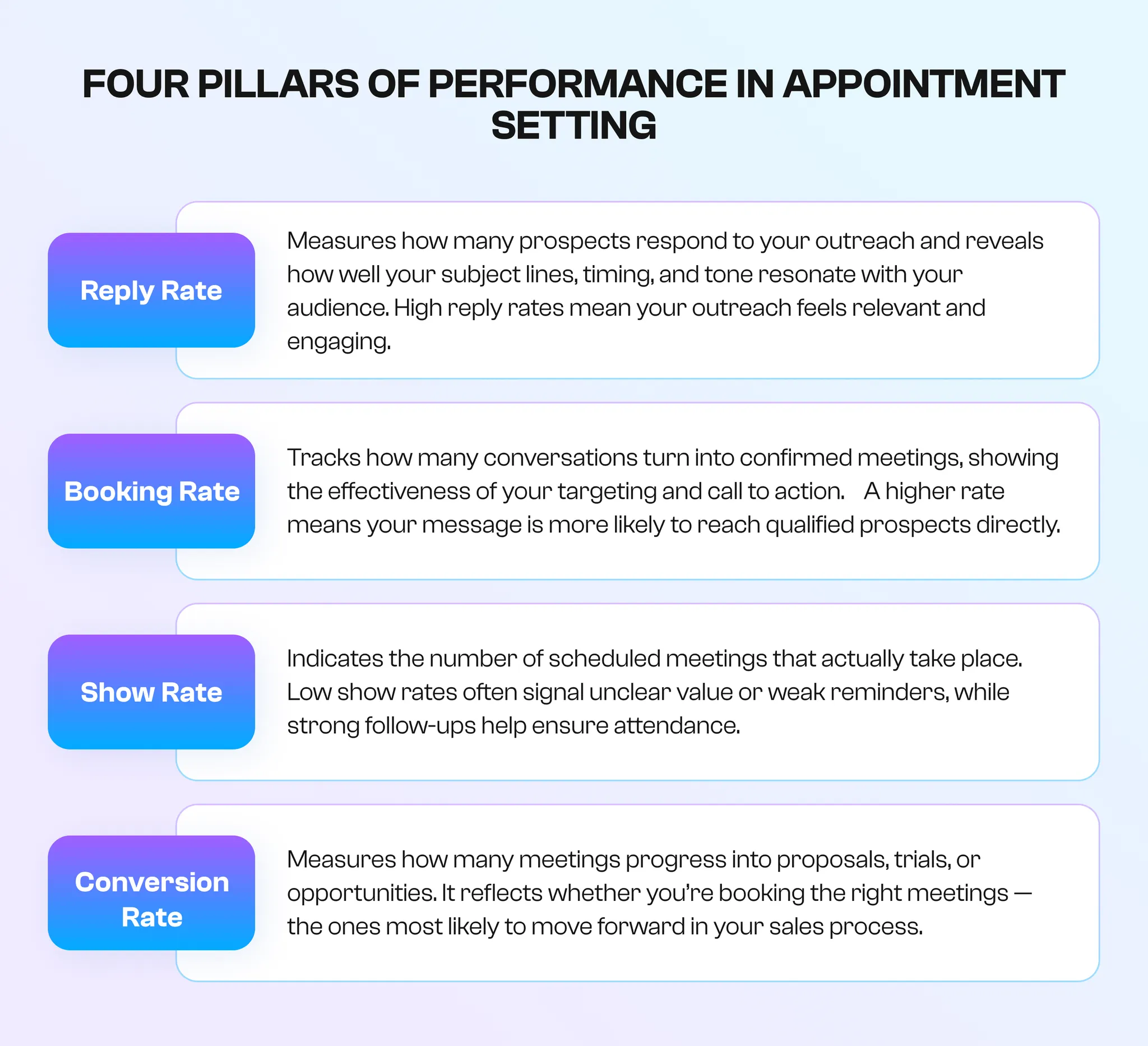
- Reply rate: The percentage of prospects who respond to your outreach (positive or negative). This shows how well your subject lines and message hooks resonate.
- Booking rate: The share of total contacts that turn into confirmed meetings — a direct indicator of targeting quality and CTA effectiveness.
- Show rate: The percentage of booked meetings that actually happen. Low show rates often mean unclear value or weak reminders.
- Conversion rate: How many meetings move into the following steps: proposals, trials, or opportunities. This reveals whether you’re booking the right meetings, not just more of them, and ties directly to understanding what a reasonable lead generation conversion rate looks like in your industry.
Top-performing teams track these KPIs weekly and see 31% faster pipeline movement compared to teams that review results monthly.
The next step is building feedback loops. Analyze which segments reply faster, which subject lines convert better, or which time slots get more responses. Feed those insights back into your next campaign. That’s how your process evolves, rather than repeating mistakes.
A common pitfall is testing too many things at once. If you change your subject line, CTA, and send time together, you won’t know what caused the difference. The smart move? Test one variable at a time and isolate your experiments like a scientist, not a gambler.
At SalesAR, our reps run small A/B tests weekly, adjusting phrasing, tone, and timing, and then scale what performs best. Over time, that incremental optimization adds up to exponential improvement.
The point isn’t perfection; it’s progression. Appointment setting is a living system. When you measure, learn, and adapt continuously, your meetings become predictable, your pipeline becomes steady, and your success stops depending on luck.
Creative Ways to Boost Meeting Bookings
If your outreach feels the same as everyone else’s, your results will be the same. In sales appointment setting, buyers are used to polished templates — what catches their eye is something that feels tailored, relevant, and timely.
Weaving creativity into your appointment-setting strategy with value-driven hooks like free audits, event-based invites, or limited-slot consultations. These are proof that you’re confident in your value. Offering a short audit or insights report gives prospects a reason to engage without pressure. Event-based messaging (like inviting them to a webinar or product preview) creates context, while limited availability signals credibility without sounding salesy.
A few creative ways to stand out:
- Offer insight before asking for time. Share a quick, personalized takeaway from their latest blog or product update (“I noticed your team just launched X — here’s what similar companies improved after Y months”).
- Tie outreach to moments that matter. If their company has just hit a funding milestone or announced an expansion, use that as a reason to reach out.
- Use scarcity with integrity. Instead of generic “limited slots,” say “we’re scheduling five audit calls this month for SaaS firms scaling in DACH.” Specificity builds trust.
Here’s an example that worked wonders for one of our clients:
A SalesAR campaign for a logistics tech company offered a “10-minute ROI snapshot” — a mini audit estimating how much time or cost their platform could save based on the prospect’s data. It wasn’t a hard sell; it was just a quick, valuable insight. The result? A 38% increase in meetings booked within three weeks. That’s the power of adding a little imagination to a structured process.
Conclusion
Booking more meetings has nothing to do with sending more messages. It’s about knowing who to reach, what to say, and when to say it. The most successful sales reps don’t rely on luck or volume; they rely on alignment, timing, and steady follow-up — the fundamentals of reliable appointment setting.
When you focus on qualified intent, build genuine connections, and personalize every touchpoint, outreach stops feeling like a chore. It becomes a predictable system, one where each conversation moves you closer to a real opportunity. Because when your message matters, a meeting is just the natural next step.
Book your consultation with SalesAR and discover how our team turns targeted outreach into qualified, sales-ready conversations that grow your pipeline fast.
FAQ
What is appointment setting in sales?
Appointment setting is the process of connecting sales reps with qualified prospects through booked meetings. It bridges the gap between lead generation and closing, turning potential interest into scheduled conversations with decision-makers who fit your ideal customer profile.
How can sales reps increase the number of appointments they book?
The key is to focus on quality over quantity. Reps should define their ICP clearly, personalize every message, and use a structured multi-channel approach that combines email, LinkedIn, and phone outreach. We recommend at least six to eight touches per lead. 20–25% of meetings are booked after the fourth follow-up. Consistency and persistence consistently outperform volume.
What tools help sales reps with appointment setting?
The most effective appointment setters use an integrated tool stack that connects their CRM, outreach, and scheduling processes. Platforms like HubSpot or Pipedrive help track interactions, while Apollo or Salesloft automate follow-ups. Tools such as Calendly make scheduling effortless.
How can sales reps reduce no-shows for scheduled appointments?
The simplest way to prevent no-shows is to confirm meetings and communicate value ahead of time. Sending a short reminder 24 hours before the call with a clear agenda and meeting link shows professionalism and commitment. Structured reminders and clear expectations can cut no-shows by up to 25%.