










In 2025, pricing for B2B appointment setting swings from a few hundred dollars a month to tens of thousands. But here’s the catch: those numbers don’t tell the whole story. Behind every quote is a different mix of strategy, data quality, tech stack, and how deeply the provider embeds into your sales process.
Companies that partner with professional outbound agencies report 40–60% faster pipeline growth compared to in-house outreach teams. According to Clutch, the average cost per qualified B2B appointment in 2025 is between $550 and $ 1,700. So, what are you really paying for?
Why Appointment Setting Is More Than Just “Booked Meetings”
You’ve probably seen those flashy offers: “We’ll book 50 meetings for $1,000.” Sounds like a bargain until your sales team spends 80% of its week talking to the wrong people.
Cheap meetings often mean shallow targeting, scraped contact lists, and prospects who barely fit your ideal customer profile. You might fill your calendar, but your pipeline stays empty. The truth is, not all meetings are created equal — and only a fraction of low-cost appointments ever turn into real sales opportunities.
What you’re really paying for in a professional B2B appointment setting is the quality of everything that happens before the meeting appears on your calendar:
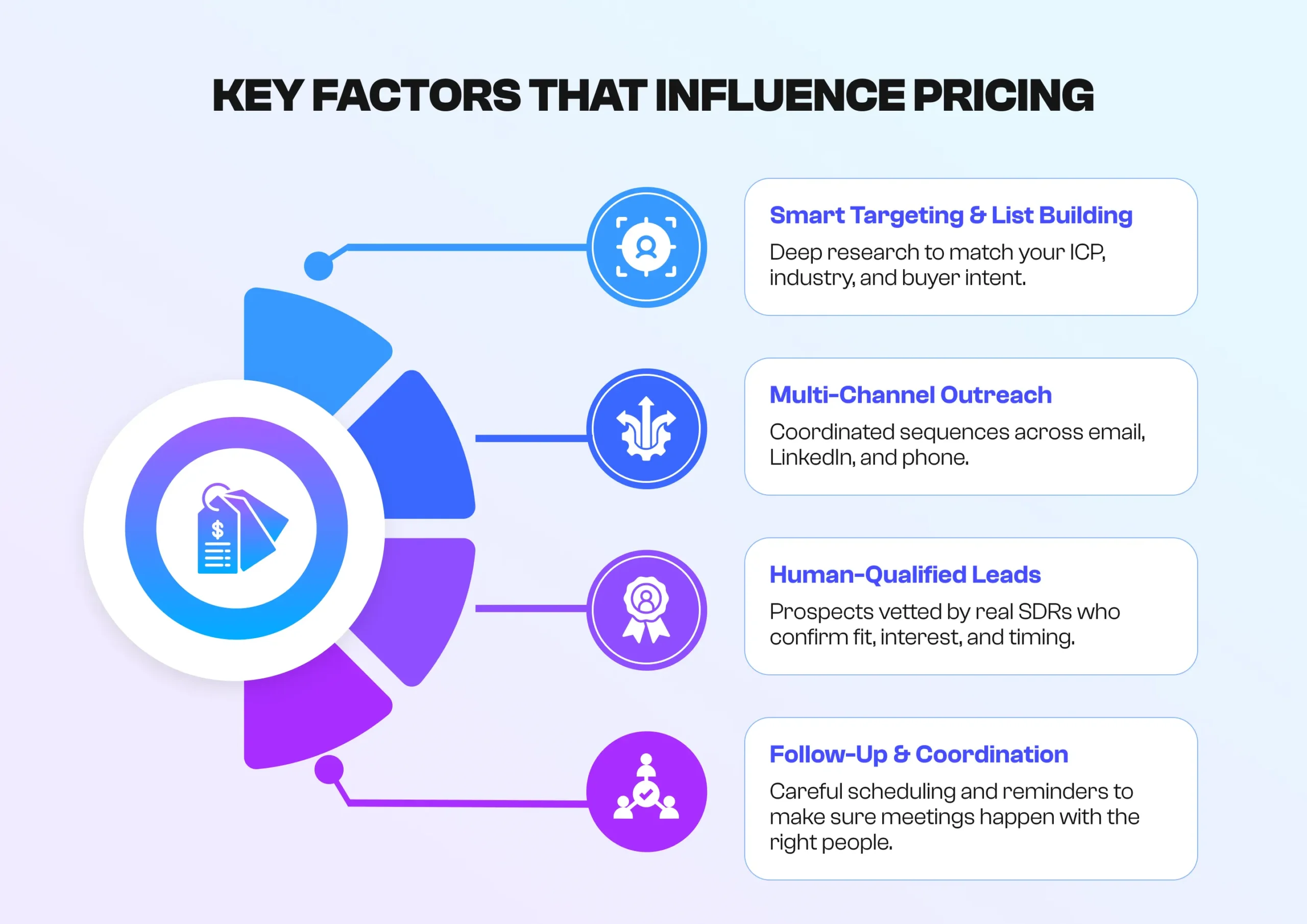
- Smart targeting and list building: Deep research to match your ICP, industry, and buyer intent so your team speaks only with the right prospects.
- Multi-channel outreach: Coordinated messaging across email, LinkedIn, and phone to improve response rates and build trust before the call.
- Human-qualified leads: Every meeting is vetted by SDRs to confirm fit, interest, timing, and opportunity.
- Follow-up and coordination: Effective scheduling and reminders ensure meetings actually happen with the right stakeholders.
What Drives Appointment Setting Pricing in 2025
Let me tell you about two clients who couldn’t be more different.
Client A was a U.S.-based SaaS startup targeting CFOs at mid-market firms. Their goal was to book 40 high-quality meetings per quarter — the kind that could turn into $50,000+ contracts. For that, they paid around $400 per qualified meeting.
Client B, on the other hand, was a manufacturing supplier reaching out to small distributors and logistics companies across the EU. Their average deal size was smaller, and they were fine with volume over precision. Their cost per meeting? Roughly $80–$150.
Both got results — but their budgets, strategies, and expectations were completely different. And that’s the story of appointment setting in 2025: pricing isn’t random, it’s driven by who you’re trying to reach, how you get them, and how much human effort it takes to make those conversations happen.
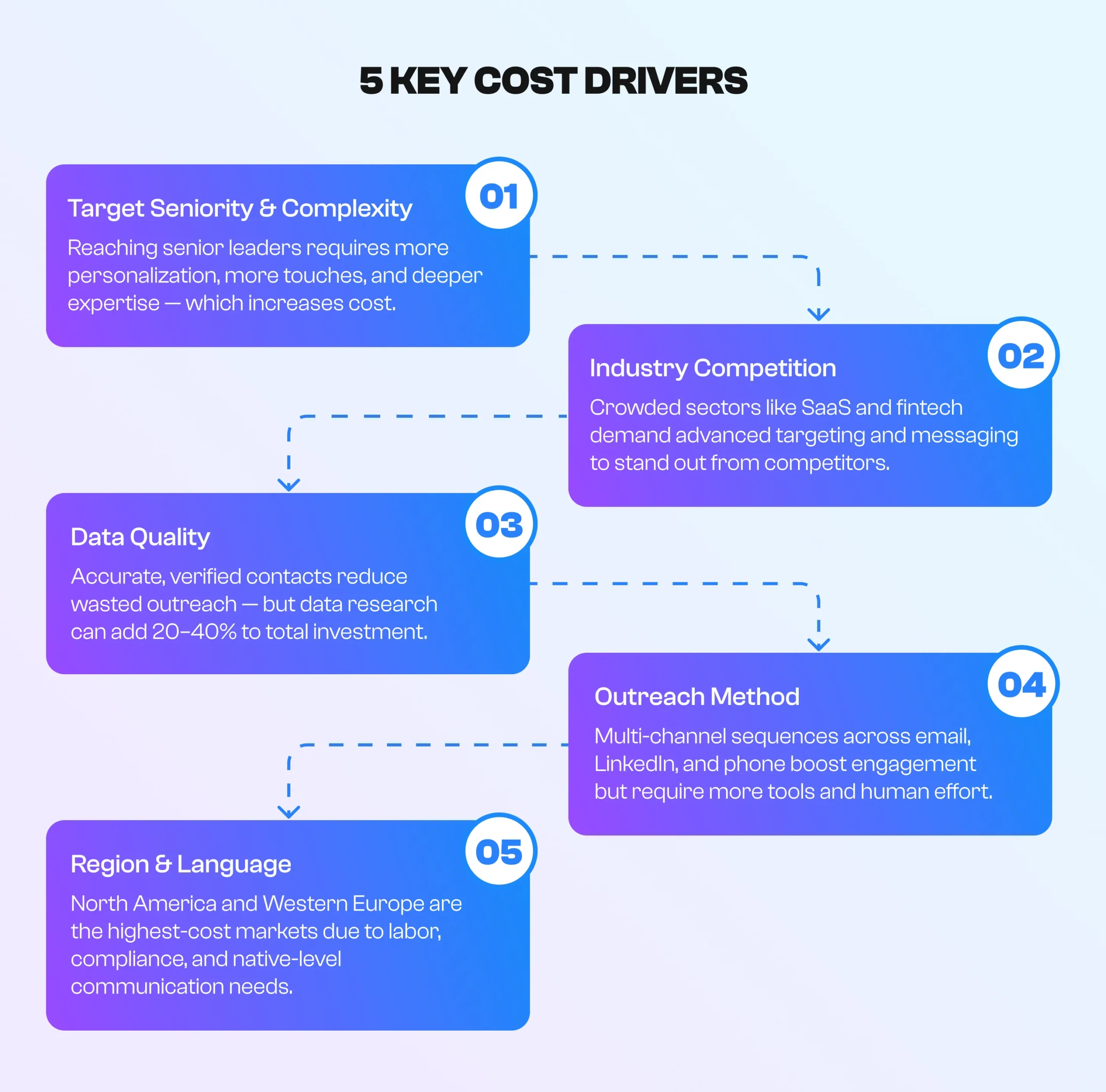
1. Target Seniority & Complexity
The higher you aim, the harder it gets. Executives, including CFOs, CTOs, and VPs, expect relevance, context, and credibility. An SDR can reach 20 mid-level managers in a day, but getting a meeting with one senior executive might take dozens of personalized touches across multiple channels.
Every level of decision-maker adds complexity — not just in messaging, but in how you build your outreach strategy. You might need case studies, industry references, or a multi-step nurture flow before the prospect even agrees to talk.

SalesAR Insight: That’s why enterprise campaigns often cost 2–3 times as much per meeting as SMB-focused campaigns. You’re paying for time, expertise, and patience.
2. Industry Competition
Reaching decision-makers in SaaS, fintech, or cybersecurity is a whole different game from, say, logistics or manufacturing. These high-competition industries are flooded with outbound emails every day. Standing out requires deeper research, tailored messaging, and more touchpoints.
When you’re competing for the same attention span as hundreds of other vendors, success depends on how precise your targeting and messaging are. That precision costs extra, but it’s the only way to get meaningful engagement in crowded markets.
3. Data Quality
Building accurate, verified contact lists is often the most underestimated cost in appointment setting. Reliable data research can add 20–40% to your total campaign cost — but it’s also what separates effective campaigns from spam folders. Think of it as your campaign’s foundation: wrong email, wrong title, wrong timing, and the whole thing collapses.
In 2025, many agencies have moved away from static databases to custom data sourcing, where every lead is hand-verified or intent-mapped. It’s slower, but it improves connect rates and reduces wasted effort.
4. Outreach Method
Single-channel email campaigns are fading fast — buyers expect to be approached thoughtfully across multiple touchpoints. A multi-channel strategy using email, LinkedIn, and phone outreach yields up to 2.5x higher response rates, but it also doubles operational costs. Why? Because it requires more tools, more coordination, and more people.
Each additional channel adds layers: copywriting for email, profile optimization, and LinkedIn engagement, and SDRs trained in cold calling. It’s more work, but it’s worth it.

SalesAR Insight: 84% of B2B buyers prefer engaging with vendors through multiple channels before committing to a meeting.
5. Region & Language
Outreach to North America and Western Europe is still the most expensive, driven by higher SDR labor costs, stricter privacy regulations, and the need for native-level communication. Campaigns targeting LATAM, Eastern Europe, or Southeast Asia are more cost-efficient — but they may require translation or cultural adaptation to maintain professionalism.
Reaching SMBs in your own country might cost you $100 per meeting. Targeting enterprise executives across continents could reach $600–$900. The difference lies in the quality of targeting, the channels you use, and how much of the heavy lifting your vendor handles behind the scenes.
Book a call with SalesAR and see how our omnichannel approach can help you turn conversations into conversions.
Appointment Setting Pricing with Real Ranges and Trade-Offs
Some appointment setting pricing models favor fast results, while others focus on precision and scalability. Let’s break down the most common ones you’ll come across — what they really mean, what they cost, and when each makes sense.
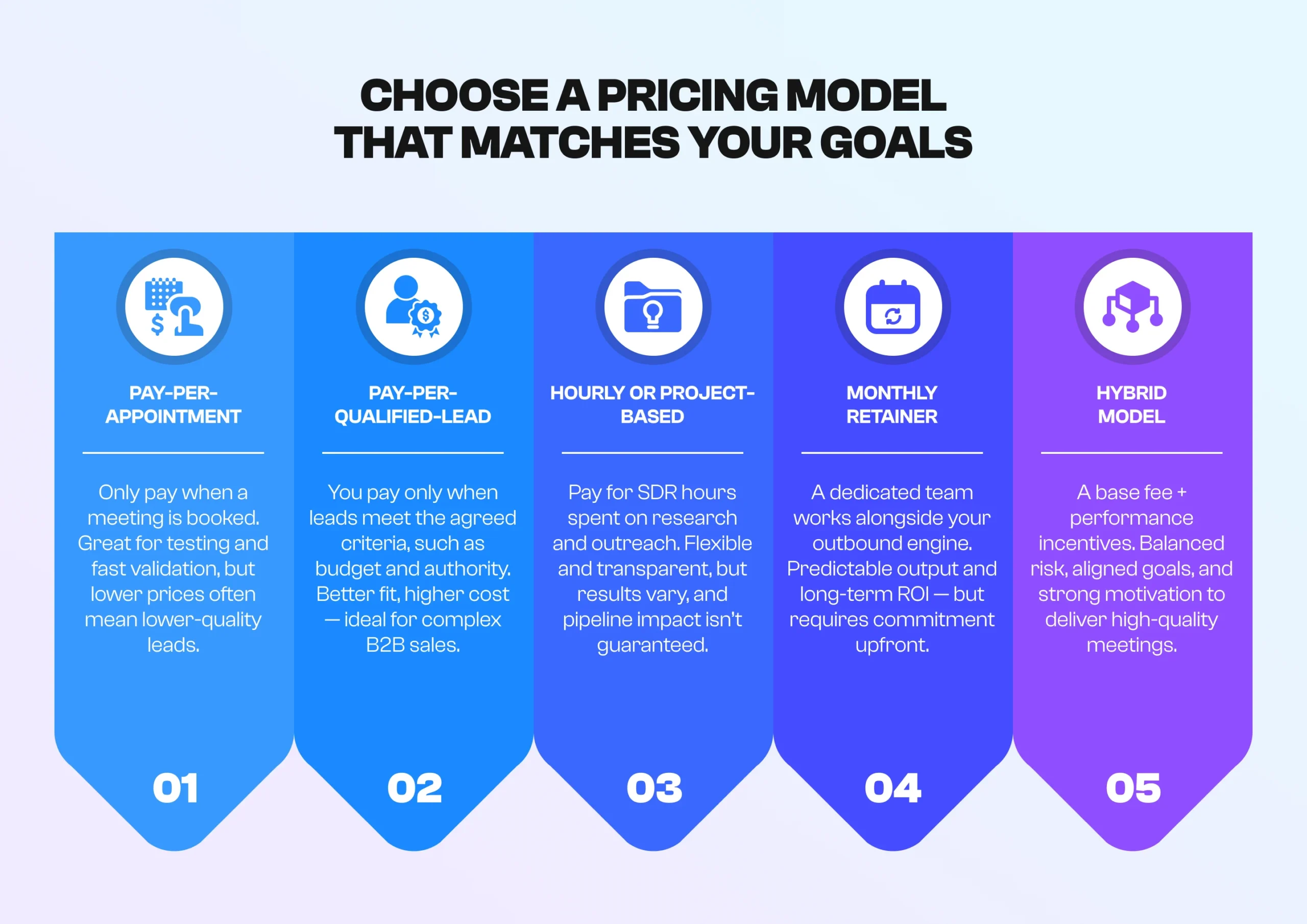
Pay-Per-Appointment
“Pay only when we book a meeting” sounds perfect — who wouldn’t want guaranteed results with no upfront risk? The reality, though, is a little trickier.
The pay-per-appointment model charges you for every meeting that lands on your calendar, regardless of what happens afterward. Prices range from $50 to $500 per appointment, depending on your target industry and region. It’s often used by startups testing outbound for the first time or companies running simple, transactional sales.
But the downside is hidden in the word “qualified.” When pricing drops below $100 per meeting, you’re usually buying quantity rather than quality. Vendors using this model often cast a wide net, scraping lists and pushing volume to hit targets. The result? Lots of conversations, very few conversions.
For simple outreach or early-stage validation, this model can work. It helps prove demand and gather feedback without heavy investment. But for complex B2B sales, pay-per-appointment often becomes a false economy. You save on the surface, but spend far more chasing unqualified leads later.
Pay-Per-Qualified-Lead
This model takes the pay-per-appointment structure and adds a layer of precision. Instead of paying for any meeting, you only pay when a lead meets predefined qualification criteria — typically BANT (Budget, Authority, Need, Timeline), CHAMP, or your own custom framework.
Costs range from $50 to $1,000+ per lead, depending on the complexity of your offer and target audience. It’s common in high-ticket industries like cybersecurity, AI solutions, or infrastructure tech, where a single closed deal can justify months of outreach.
But this model demands alignment between both sides. The provider must fully understand your ICP, qualification filters, and buyer personas. The process usually includes manual verification, email/phone validation, and SDR-led qualification calls.
Hourly or Project-Based
You hire SDRs or a small outbound team for a defined number of hours, typically billed at $25–$75 per hour per SDR. You see exactly where time goes: prospecting, email writing, data cleaning, or outreach execution.
For pilot programs, market testing, or exploring new territory, this setup works great. You get hands-on insights without locking into lengthy contracts. Many companies use it to validate a niche or new ICP before scaling.
Hourly campaigns are great for testing new markets, but not for scaling. You can’t forecast revenue on billable hours. Without performance incentives, agencies may lack motivation to push conversions. The work gets done, but there’s no guarantee of booked meetings or qualified leads.
Monthly Retainer (Subscription Model)
You pay a fixed monthly fee, typically between $3,000 and $10,000+, covering everything from SDR labor and data research to tech stack and campaign management. It’s an outsourced team that works as an extension of your own sales department.
The biggest advantage? Predictability. You can plan your pipeline, forecast results, and align outbound performance with internal sales goals. After a few months of collaboration, agencies usually refine messaging, targeting, and timing to achieve consistent output.
SalesAR Insight: Businesses that maintain retainer-based partnerships for over six months see a 2.4x ROI improvement compared to short-term or transactional campaigns.
It’s ideal for growing SaaS, tech, and professional services firms that rely on consistent deal flow and cross-team collaboration.
The downside is commitment. You’re paying whether meetings are booked or not, especially early on, while campaigns ramp up. But unlike one-off models, this setup builds long-term efficiency. In other words, you’re building a repeatable pipeline. And that’s the kind of investment that pays off long after the first contract ends.
Hybrid Model (Base + Performance Bonus)
The hybrid pricing model combines the best of both worlds: a fixed monthly base fee plus a variable payment tied to performance. Think $2,000–$4,000 base + $150–$400 per qualified meeting.
This structure is becoming the sweet spot for companies that want reliability and accountability in equal measure. You cover the agency’s operational costs while keeping incentives aligned with your outcomes. Everyone wins when the meetings are qualified.
Top appointment setting companies, like SalesAR, often use this approach for B2B clients running complex outbound campaigns across multiple channels. The base ensures continuous work on strategy, research, and nurturing; the performance bonus motivates the team to deliver tangible results.
The hybrid model also creates flexibility. If one month is slower, you still maintain baseline activity. When results surge, you happily pay the bonus because you’re seeing pipeline growth in real time.
How to Pick the Right Model for Your Business
The key is choosing a model that aligns with how your team sells and scales. Here’s a quick checklist of what works in practice:
- Start small with a pilot. Run a 1–2-month test campaign before committing to the long term. Measure not just meeting volume but reply quality, no-show rate, and conversion to SQLs. A short pilot will reveal if the agency truly understands your audience.
- Ask about qualification logic. Clarify how they define and verify a “qualified lead.” Do they confirm budget, authority, and intent — or just anyone who replies? Reliable vendors can show you their vetting process and sample lead reports.
- Check transparency. Expect weekly syncs, shared dashboards, and real-time updates. If you can’t see campaign data, response rates, or pipeline metrics, the partnership will always feel like a guessing game.
- Own your data. All contacts, messages, and outcomes should remain in your CRM. You’re paying for outreach, so you should keep the leads for follow-ups, remarketing, or re-engagement later.
- Look for collaboration, not outsourcing. The best agencies behave like part of your team — sharing insights, refining ICPs, and adapting strategy as they go. Appointment setting works best when both sides are aligned on one goal: turning meetings into measurable revenue.
Conclusion
Don’t fixate on the price tag alone. Focus on what you’re really buying: targeting accuracy, qualification depth, and consistent collaboration. Test different models, track every result, and refine as you go.
The right model fills your pipeline with conversations that convert. Every booked meeting is either a door opener or a dead end — and the difference lies in choosing partners who understand your market as well as you do.
If you treat appointment setting as a strategic growth channel rather than a quick fix, the ROI will speak for itself.
Want to see real pricing examples and ROI breakdowns? Explore SalesAR case studies and see how we helped a client book 75+ meetings per month with high-intent, sales-ready leads.
FAQ
What is the average cost of B2B appointment setting in 2025?
The average cost per qualified B2B appointment ranges from $350 to $700, depending on the complexity of your sales process, target industry, and region. Campaigns aimed at SMBs or local businesses can cost as little as $80 per meeting, while enterprise-level outreach to senior executives in sectors like SaaS, IT, or fintech can reach $1,000 or more per qualified meeting.
Which pricing models are most common for appointment-setting services?
Most appointment setting agencies use one of five structures: pay-per-appointment, pay-per-qualified-lead, hourly or project-based, monthly retainer, or hybrid. The pay-per-appointment and pay-per-lead options work well for testing and short-term outreach, while retainers and hybrid models are preferred for ongoing, strategic campaigns that require deeper integration and long-term consistency.
Which factors influence appointment setting costs the most?
The biggest cost drivers are your target audience, industry competition, and outreach method. Data quality also plays a significant role — verified and segmented lists cost more but significantly improve conversion rates —while multi-channel campaigns double operational costs.
How can a business ensure ROI from appointment-setting services?
The key to strong ROI lies in clarity, collaboration, and consistent tracking. Start with a short pilot to benchmark performance, define clear qualification criteria, and maintain full transparency with your vendor through regular updates and dashboards. Always retain ownership of your leads and follow up quickly after meetings.
Let’s find out together! Book a call with SalesAR and see how we can help you reach the next growth stage.