









Which B2B appointment setting companies deserve a place on your shortlist this year, and how do you tell a real sales partner from a calendar filler? That question lands in my inbox every week, usually from a sales leader whose reps prospect more than they close.
Here is the short version. Appointment setting companies research your ideal customers, reach out on your behalf, qualify the people who reply, and book them into your calendar. Many providers package this as full appointment setting services covering data, messaging, and deliverability.
- Best B2B Appointment Setting Companies in 2026 (Comparison)
- How We Evaluated Appointment Setting Companies
- Top B2B Appointment Setting Companies Reviewed
- What Makes a Good Appointment Setting Company?
- Appointment Setting Company vs Lead Generation Company
- How Much Do Appointment Setting Companies Charge?
- In-House SDR Team vs Appointment Setting Company
- Why SalesAR Is Included Among B2B Appointment Setting Companies
- FAQ
The catch? Two agencies can charge the same fee and deliver very different results, because they differ in ICP (ideal customer profile) research depth, channels, what “qualified” means in the contract, industry knowledge, and pricing.

Quick answer: The best B2B appointment setting companies in 2026 combine precise targeting, multi-channel outreach, clear qualification, and pipeline reporting. Typical programs cost $3,000–$10,000 per month. Choose a provider based on ICP fit, lead quality, and cost per opportunity.
Best B2B Appointment Setting Companies in 2026 (Comparison)
Every agency blog publishes a ranking, and every ranking puts the author first. So let me be upfront: SalesAR sits on this appointment setting companies list, and the final section explains why. The table helps you compare appointment setting companies on review depth, ICP research, channel coverage, and how clearly each provider defines a qualified meeting.
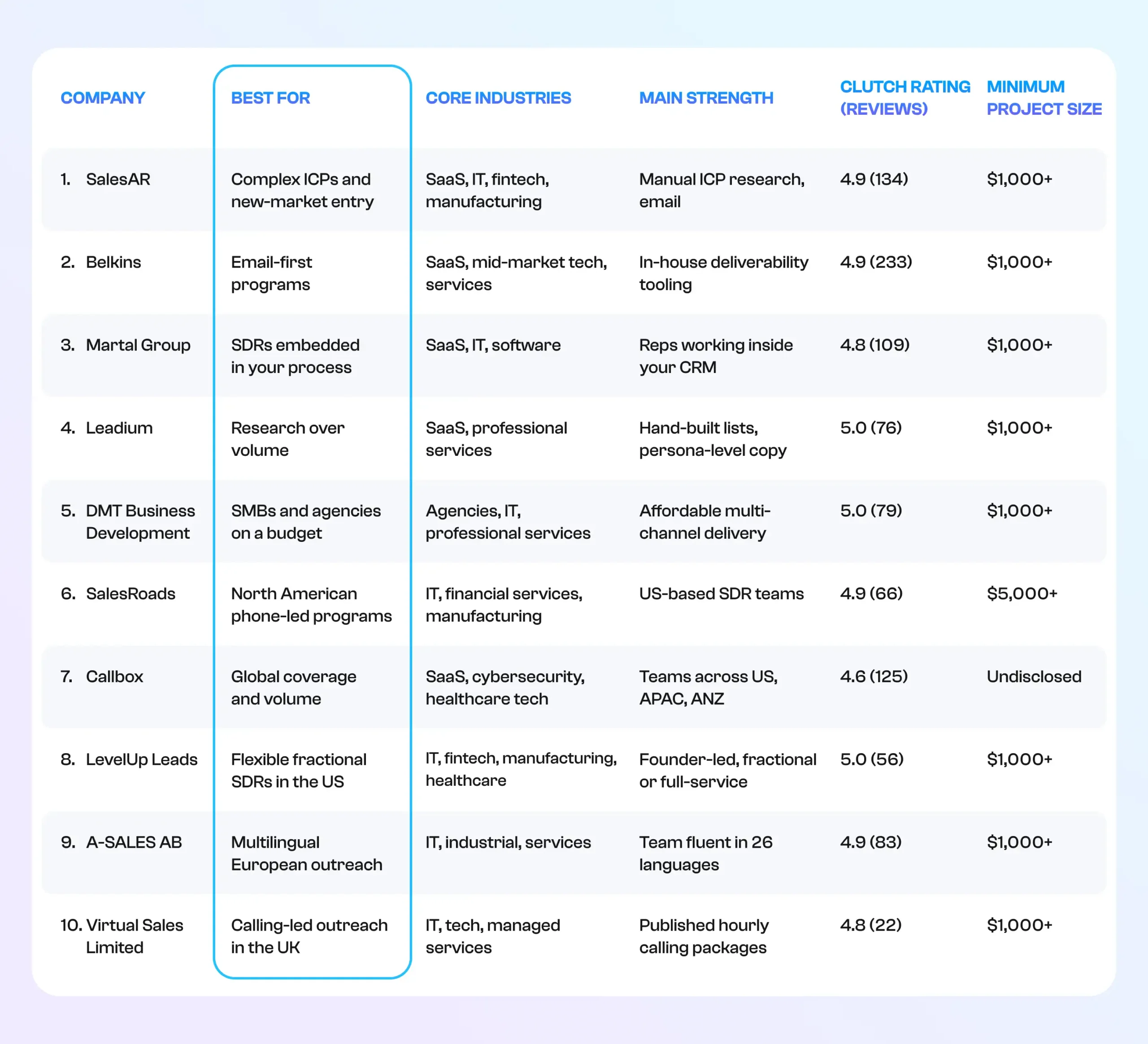
Clutch ratings, review counts, and minimum project sizes reflect provider profiles on Clutch as of August 2026.
How to read this ranking
Ratings tell you less than review depth does: a 5.0 built on 22 reviews and a 4.6 built on 125 describes different levels of exposure. ICP fit picks the winner among the top B2B appointment setting companies.
How We Evaluated Appointment Setting Companies
Four criteria carried the most weight: targeting expertise, qualification process, outreach channels, and industry experience. Reporting quality and pricing transparency acted as tiebreakers.
ICP and targeting expertise
The first thing I want to know about any appointment setting agency is whether it generates contacts or understands buyers. Anyone can export 5,000 names; far fewer teams can explain why a VP of Operations will reply while the CFO ignores you. According to Forrester (2026), the typical B2B buying decision involves 13 internal stakeholders and nine external influencers. B2B prospecting that ignores this books meetings with the wrong person.
Qualification process
Ask two questions before you sign: Who counts as a qualified prospect, and how do you verify fit before booking? A provider that promises 30 qualified appointments a month without asking about your deal size has already shown you its definition of quality. Good sales meetings come with a written standard covering title level, company size, confirmed pain, and timeline, plus a no-show replacement policy.
Outreach channels
Email remains the backbone for most outbound sales companies, LinkedIn adds a personal touch for senior buyers, and calling wins where decision-makers still pick up. According to Hunter, the average cold email reply rate is 4.5%, which explains why single-channel programs struggle. Comparing appointment setting providers, I looked for:
- Email infrastructure with domain warm-up, SPF, DKIM, and DMARC handled in-house
- LinkedIn as a second touch for prospects who ignore email
- Calling capacity, core or as an add-on, for phone-first markets
- One owner coordinating every channel
Current outbound appointment setting trends point the same way: fewer touches, better timing, cleaner data.
Industry experience
An agency that has never sold into your vertical will learn on your budget. SaaS appointment setting companies need to understand product-led competitors and technical evaluators; IT appointment setting companies face long cycles, procurement gates, and security reviews.

A SaaS appointment setting case study with 297+ booked meetings tells you more than any awards page.
Top B2B Appointment Setting Companies Reviewed
Details come from provider websites and Clutch profiles as of August 2026. Prices are directional because every one of these top B2B appointment setting companies quotes per scope.
1. SalesAR

- Overview: A B2B lead generation and appointment setting company based in London, Kyiv, and Dover, Delaware: 650+ projects, 40+ countries, 30,000+ meetings.
- Best for: Complex ICPs, long sales cycles, and entry into new regions.
- Industries served: SaaS, IT, fintech, manufacturing, logistics, cybersecurity, and 30+ verticals in total.
- Main strengths: Manual prospect research, an in-house anti-spam team, 12% to 15% reply rates, and launch within 7 to 14 days.
- Potential limitations: Calling is an add-on to email and LinkedIn, so phone-first sellers should confirm scope.
See how our B2B appointment setting services work →
2. Belkins
- Overview: One of the most visible names in cold email; the Denver-based team owns Folderly, a deliverability product wired into its campaigns.
- Best for: Email-first teams that need inbox placement protected across multiple domains.
- Industries served: SaaS, software, mid-market tech, healthcare, and professional services.
- Main strengths: Deep email expertise, deliverability monitoring, CRM integration, and a large case study library.
- Potential limitations: Phone plays a supporting role, and reported retainers cluster between $4,000 and $8,000 per month.
3. Martal Group
- Overview: Oakville, Canada-based Martal embeds outsourced SDRs and account executives into client teams; reps join your standups and work in your CRM.
- Best for: SaaS and IT companies that want reps woven into their own process.
- Industries served: Software, IT services, business services, logistics, energy, and telecom.
- Main strengths: Tech vertical depth, tiered packages with pay-as-you-go options, and fast messaging adjustments.
- Potential limitations: Cost climbs as you add reps and channels; some reviews ask for earlier metric visibility.
4. Leadium

- Overview: The boutique option: the Las Vegas-based agency builds lists by hand, writes copy per persona, and keeps fewer accounts per manager.
- Best for: Mid-market and SaaS teams that value research over send volume.
- Industries served: SaaS, fintech, professional services, and B2B software.
- Main strengths: Precision targeting, personalized messaging, a US-based team, and high show rates per client review.
- Potential limitations: Personalization limits throughput, and a few reviewers flagged setup timelines.
5. DMT Business Development

- Overview: Ottawa-based DMT covers appointment setting, cold calling, email, LinkedIn growth, and data research, with average project cost under $10,000.
- Best for: SMBs, agencies, and startups that want multi-channel outreach on a modest budget.
- Industries served: Digital agencies, IT, professional services, SaaS, and consulting.
- Main strengths: Competitive pricing, responsive communication, and roughly 10 to 42 booked meetings per project.
- Potential limitations: Engagements skew small; verify capacity before running named-account programs.
6. SalesRoads
- Overview: SalesRoads runs US-based SDR teams from Boca Raton, Florida, and relies on trained callers over automation; its $5,000+ minimum is the highest entry point here.
- Best for: North American companies whose first conversation needs a human voice.
- Industries served: IT, financial services, manufacturing, real estate, and healthcare.
- Main strengths: Domestic reps, custom talk tracks per client, and flexibility praised across reviews.
- Potential limitations: Retainers reportedly start near $6,950 per month, and completed projects sit almost entirely in the US.
7. Callbox
- Overview: Founded in 2004, Callbox is the largest company here, with 1,000+ employees across the US, APAC, and ANZ running phone, email, LinkedIn, web chat, and event outreach.
- Best for: Global coverage, large top-of-funnel activity, and time-zone-aligned calling.
- Industries served: SaaS, cybersecurity, AI, healthcare tech, financial services, and manufacturing.
- Main strengths: Scale, channel breadth, 20+ years of process, and reported pricing of $2,000 to $5,000 per month.
- Potential limitations: The rating trails others here, and appointment setting is 17% of the company’s focus per Clutch.
8. LevelUp Leads
- Overview: A founder-led sales development agency in Laguna Beach, California, offering fractional and full-service SDRs, cold calling, and list building.
- Best for: US companies that want to scale SDR capacity up or down quickly.
- Industries served: IT, fintech, healthcare, manufacturing, MSPs, and marketing agencies.
- Main strengths: Flexible fractional model, US-based reps, daily Slack communication, in-house tech stack.
- Potential limitations: Pricing is quoted on request, and completed projects sit almost entirely in the US.
9. A-SALES AB
- Overview: Sweden-based A-SALES AB has completed projects in 22 countries with a team fluent in 26 languages; clients report up to 300% more appointments.
- Best for: Companies targeting the Nordics, DACH, or wider Europe in native languages.
- Industries served: IT, industrial and manufacturing, professional services, and SaaS.
- Main strengths: Multilingual delivery, tailored messaging, and good value, with most projects under $10,000.
- Potential limitations: Appointment setting is 30% of the firm’s focus, so clarify which service line your program falls under.
10. Virtual Sales Limited
- Overview: A UK agency in Horsham with published calling packages: $3,000 for 40 hours, $4,500 for 75 hours, and $7,000 for 140 hours a month, data and weekly reporting included.
- Best for: UK and European IT and managed service providers that want calling-led outreach.
- Industries served: IT services, technology, MSPs, and digital agencies.
- Main strengths: Predictable pricing, UK-based project managers, and 6 to 10 meetings per month per client review.
- Potential limitations: A small team, modest volumes, and a calling-centered program; confirm email and LinkedIn scope.
Start with a free lead generation audit.
We review your current outreach, data, and messaging, then tell you what a realistic pipeline looks like before you commit to any agency, including us.
What Makes a Good Appointment Setting Company?
Most listicles stop at the ranking. The core of how to choose an appointment setting company is what separates a provider that fills your calendar from one that fills your pipeline.
Strong ICP research
Good appointment setting firms start with the buyer and only then move to outreach: a research team verifies each contact by hand, checks firmographic fit, and tags trigger events such as funding rounds or conference attendance. Dedicated B2B prospect research costs more up front and pays for itself in reply rates.

Across 650+ projects, the campaigns that underperformed almost always shared one trait: the list came from database filters alone. A human research step before sending typically doubles reply rates, because researchers catch the wrong-title and wrong-size contacts that databases miss.
Qualified meetings over raw volume
More meetings and more pipeline are different outcomes. Ten conversations with decision-makers who confirmed a pain point create more revenue than forty polite intros with junior staff. Providers who understand this report on held meetings and opportunity conversion, and walk away from bookings that fail the standard.
Transparent reporting
You should see the whole funnel every week, without asking:
- Activity: emails sent, LinkedIn touches, and calls placed per segment
- Replies: total, positive, and objections grouped by theme
- Meetings: booked, held, and no-show rate
- Conversion: meeting-to-opportunity rate scored by your account executives
- Pipeline contribution: opportunity value and closed-won revenue from outbound
Ability to optimize campaigns
The first sequence rarely wins. Strong providers change targeting, messaging, and channel mix based on what replies tell them, usually within three weeks. A mature B2B lead generation process tests subject lines, offers, and segments, then shifts budget toward the winners. Ask any appointment setting agency how many sequences it tested on its last three campaigns.
Appointment Setting Company vs Lead Generation Company
Buyers mix these two up constantly, and vendors rarely help, because many sell both.
| Criterion | Appointment setting company | Lead generation company |
|---|---|---|
| Main output | Booked meetings with qualified decision-makers | Prospects, contact lists, or inbound leads |
| Main goal | Sales conversations | Pipeline creation and market coverage |
| Sales involvement | Later stage; reps join at the meeting | Earlier stage; reps qualify and follow up |
| Typical pricing | Monthly retainer, per-meeting, or hybrid | Per lead, per contact, or retainer |
Which one do you need?
- Pick lead generation companies when your reps have time to qualify and nurture.
- Pick appointment setting companies when account executives are the bottleneck.
- Plenty of teams run both: lead generation companies for inbound, and an outbound partner for cold sales meetings.
How Much Do Appointment Setting Companies Charge?
Appointment setting pricing is hard to pin down by design. Few providers publish a rate card, and those who do quote hours or contacts.
| Pricing model | How it works | Typical range (USD) |
|---|---|---|
| Monthly retainer | Fixed fee for a dedicated team and defined outreach volume; 3 to 6 month minimum terms are common | $3,000 to $10,000+ per month |
| Per meeting | Fee for each qualified meeting booked or held; check the no-show policy | $150 to $400 per meeting |
| Hybrid | Lower base fee plus a per-meeting bonus above a baseline | $2,000 to $4,000 base plus $100 to $200 per meeting |
| Project or pilot | One-time scope, often one month, to test a market | $3,000 to $6,000 per pilot |
Ranges reflect rate cards and project data published on Clutch (2026); average project cost for most providers here falls between $10,000 and $49,000.
What moves the price
Five variables explain most of the gap between a $3,000 quote and a $10,000 one: targeting complexity (niche ICPs need more manual research), geography (multi-region campaigns cost more), seniority (C-level buyers take more touches), channels (calling or LinkedIn on top of email raises labor cost), and qualification depth (confirmed-pain meetings cost more than intro calls).
How to compare quotes
Divide the monthly fee by the number of meetings that became opportunities, then hold that figure against your average deal size. A $6,000 program producing 20 meetings with 30% converting yields $1,000 per opportunity: fine for a $15,000 deal, fatal for a $3,000 one. Structured SalesAR packages follow that logic: Pilot for a one-month test, Business for three months, Enterprise for six. Appointment setting cost only makes sense next to the revenue it unlocks. For a full breakdown of pricing models and what drives cost, see our guide to B2B appointment setting pricing.

Buyers who compare vendors on cost per meeting usually pick the wrong one. Compare cost per opportunity and cost per closed deal; a $200 meeting that never converts is the most expensive line in your budget.
In-House SDR Team vs Appointment Setting Company
The alternative to hiring an agency is hiring people. Both paths work, with different risks and timelines.
| Factor | Internal SDR team | Appointment setting company |
|---|---|---|
| Hiring | Required; 4 to 8 weeks per seat | None |
| Expertise | Built internally over months | Available from day one |
| Market testing | Slower; one rep learns one market | Faster; researchers and SDRs run parallel tests |
| Ramp to first meetings | Around 3 months | 2 to 4 weeks |
| Cost structure | Salary, commission, benefits, tools, management | Flat fee or performance component |
The hidden cost of hiring
According to The Bridge Group, the average SDR takes about 3.2 months to ramp and stays in the role roughly 14 to 18 months, which leaves about a year of full productivity per hire. Add recruiter fees, tools, a manager’s time, and the pipeline gap during every vacancy, and the fully loaded cost per seat lands well above salary. SDR outsourcing trades that volatility for a predictable fee and a team that already made its early mistakes elsewhere.
When in-house still wins
Keep the function internal when speed to lead on inbound is the problem, when your sale needs deep technical discovery on the first call, or when founders still need to hear objections directly. Outsourced appointment setting companies amplify a message that already works, so product-market fit comes first. The setup I see most often in 2026 is hybrid: SDR outsourcing for cold outreach, with one or two internal reps on inbound and warm follow-up.
Why SalesAR Is Included Among B2B Appointment Setting Companies
Fair question: why trust a ranking that includes its author? Because the numbers stand on their own, and you can check each one on Clutch.
- SalesAR has completed 650+ projects in 40+ countries, booked 30,000+ qualified appointments, and worked across 30+ industries.
- Clutch rates the company 4.9 across 134 reviews and named it a top appointment setting, lead generation, and lead qualification company in 2025.
- Reply rates on active campaigns regularly reach 12% to 15%, against a cold email average of 4.5%.
Every engagement follows six steps: ICP research, manual list building, deliverability setup, multi-channel outreach across email and LinkedIn, lead engagement and booking, and ongoing optimization. Campaigns launch within 7 to 14 days, and every package includes a researcher, an SDR, an account manager, and weekly reports.
Bulu Group: 75 appointments from 875 replies
Bulu Group, a US fulfillment company serving subscription brands, came to SalesAR through a referral for a short email and LinkedIn test. The team researched 22,000+ contacts at 7,276 companies in food, nutrition, supplements, and pet brands, then A/B tested ten email sequences built around buying intent, referrals, seasonal offers, and industry events. Event-based messaging won: email delivered a 25.4% open rate, 875 replies, and 75 scheduled appointments, and LinkedIn added 764 connections and 144 more replies. This appointment setting results example is now a two-year partnership.

Bulu’s event-based sequences beat intent-based ones because shared context outperforms claimed relevance. Referencing a conference both sides attended gave prospects a reason to reply before any pitch appeared.
After a short call, we send you a free sample list of researched contacts that match your ideal customer, so you can judge data quality before any contract.
FAQ
What is a B2B appointment setting company?
A B2B appointment setting company researches your ideal customers, contacts them through email, LinkedIn, or phone, qualifies interested prospects, and books meetings into your calendar.
How do appointment setting companies work?
Most follow the same loop: define the ICP, build and verify a contact list, set up email infrastructure, run multi-channel sequences, qualify replies, book the meeting, report weekly.
What are the best appointment setting companies in 2026?
Based on Clutch data and the criteria above, the best appointment setting companies for 2026 include SalesAR, Belkins, Martal Group, Leadium, DMT Business Development, SalesRoads, Callbox, LevelUp Leads, A-SALES AB, and Virtual Sales Limited.
How do I choose an appointment setting company?
Run five checks: proof of ICP research, a written definition of a qualified meeting, channel coverage that matches your buyers, case studies in your industry, and weekly reporting tied to pipeline.
How much do appointment setting companies charge?
Monthly retainers usually run $3,000 to $10,000+, per-meeting pricing runs $150 to $400, and hybrid models combine a lower base with per-meeting fees. Compare cost per opportunity, since a cheap meeting that never converts is the priciest one.
What is the difference between appointment setting and lead generation?
Lead generation produces contacts or interest; appointment setting produces confirmed meetings with qualified decision-makers. One sits at the top of the funnel; the other sits mid-funnel and hands your reps a calendar invite with context.
Are appointment setting companies worth it?
They pay off when your deal size exceeds roughly $10,000, your close rate on qualified meetings tops 20%, and your account executives can absorb 15 to 30 new conversations a month. Below those thresholds, one internal rep usually wins, and the top appointment setting companies will say so.