









How much does lead generation cost? In 2026, B2B lead generation pricing usually lands between $2,500 and $15,000+ per month for a managed outbound program, $25 to $400+ per lead, and $300 to $1,700 per qualified appointment, according to 2026 market data I’ll cite as we go.
I hear this question every week, and my answer starts with another question: what exactly do you want to pay for? Research time, verified contact data, email infrastructure, copywriting, a sales development representative (SDR) who talks to your prospects, qualification, and reporting. Once you understand those parts, lead generation pricing becomes a shopping list you can check line by line.
- B2B Lead Generation Cost in 2026
- What Does "Lead Generation Cost" Actually Mean?
- What Is Included in B2B Lead Generation Pricing?
- B2B Lead Generation Pricing Models
- What Factors Affect Lead Generation Cost?
- B2B Lead Generation Cost by Industry
- In-House vs Outsourced Lead Generation Cost
- How Much Should Your Company Budget?
- How to Calculate the Real ROI of Lead Generation
- How to Compare Lead Generation Providers
- How SalesAR Approaches Lead Generation Pricing
- Final Thoughts
- FAQ
B2B Lead Generation Cost in 2026
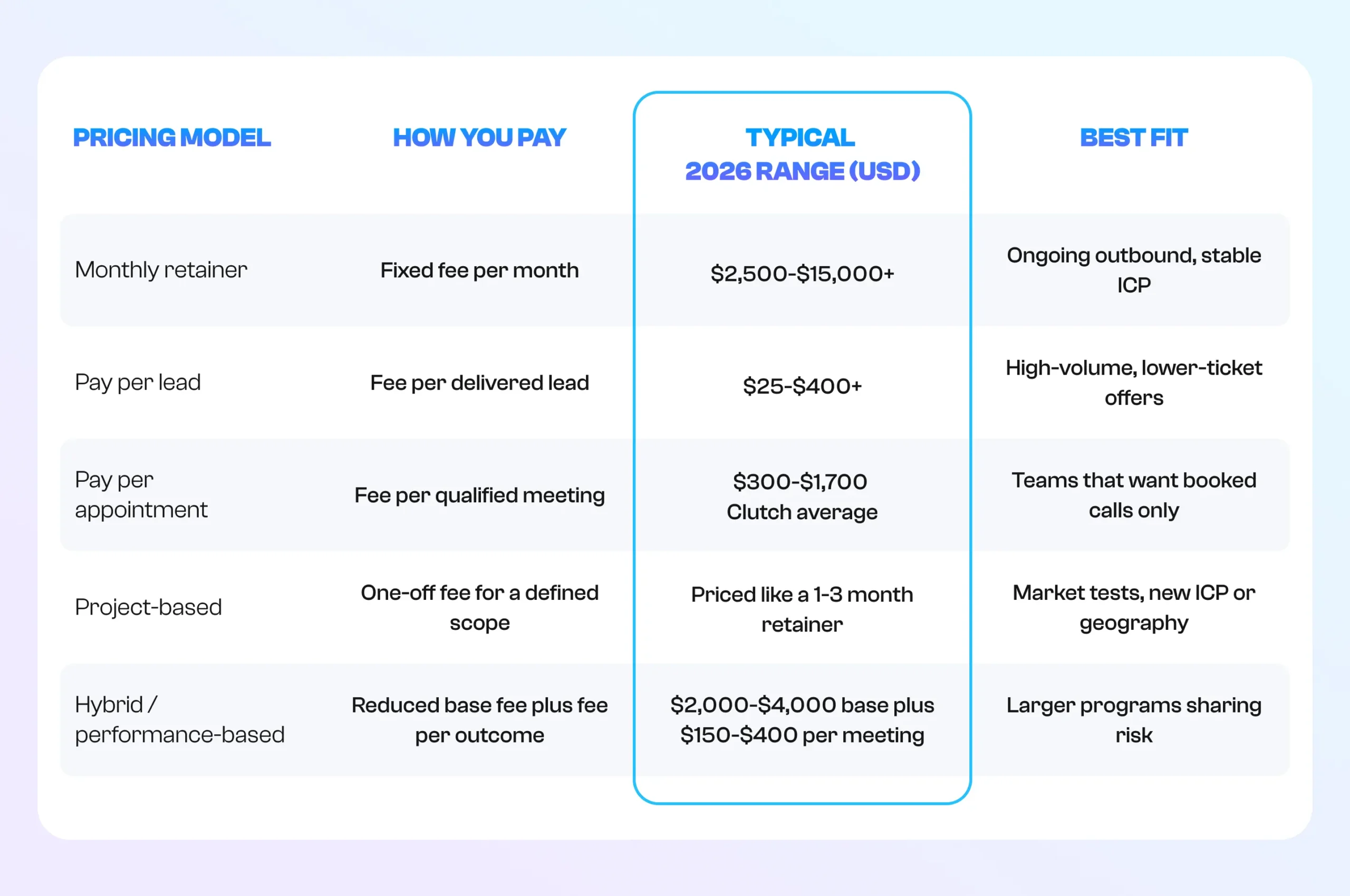
In 2026, the B2B lead generation cost for an outsourced program typically runs $2,500-$15,000+ per month on a retainer, and complex multi-channel programs can reach $25,000 per month. Pay-per-lead agreements range from $25 to $400+ per lead. Qualified appointments cost $300-$750 at performance-based providers, while the Clutch-reported average sits at $550-$1,700. The final figure depends on your industry, the complexity of your ideal customer profile (ICP), buyer seniority, the number of outreach channels, and how strictly the provider defines a “qualified” lead.
Pricing Models and Payment Formats
Why such a wide range? Because “lead generation” covers everything from a scraped list to a full outbound team, and how much you should pay for B2B lead generation depends on your deal size far more than on the sticker price.
What Does “Lead Generation Cost” Actually Mean?
Two agencies quote you $120 per lead and $380 per lead. Which one is cheaper? Trick question. Until you know what each calls a “lead,” you can’t compare the numbers.
Five Things People Call a “Lead”
Here’s the ladder, one sentence each, from cheapest to most valuable:
- Raw lead: a contact record that matches your criteria but has shown no interest yet.
- Marketing qualified lead (MQL): a contact who fits your profile and has engaged, for example by replying to an email.
- Sales qualified lead (SQL): a contact your sales team has checked for fit, need, and budget.
- Qualified meeting: a scheduled conversation with a decision-maker who confirmed interest and meets agreed criteria.
- Opportunity: a deal opened in the CRM (customer relationship management system) with a realistic chance of closing.
Each rung costs more to produce and is worth more to you. Providers quoting $30 raw leads and $600 qualified meetings are both honest. They sell different rungs.
Why Cost per Lead Alone Can Fool You
Cost per lead (CPL) is total campaign spend divided by leads produced. Cost per opportunity is total spend divided by the sales opportunities those leads became. The second number predicts revenue:
| Metric | Provider A | Provider B |
|---|---|---|
| Cost per lead (USD) | $150 | $400 |
| Leads delivered | 100 | 40 |
| Total spend (USD) | $15,000 | $16,000 |
| Lead-to-opportunity rate | 5% | 30% |
| Opportunities created | 5 | 12 |
| Cost per opportunity (USD) | $3,000 | $1,333 |
Provider B charges 2.7 times more per lead and delivers opportunities at 56% lower cost. Which invoice would you rather sign?

The cheapest meetings come from the most demanding research. When every contact is checked against the ICP by hand, reply rates reach 12-15% on our strongest campaigns, and cost per meeting drops even though research costs more.
What Is Included in B2B Lead Generation Pricing?
Where does the money go? Here’s the lead generation services cost stack most agencies are pricing, whether they itemize it or fold it into one line.
Before the First Message Goes Out
- Strategy: channel mix, messaging angles, targets, and timeline.
- ICP development: deciding which companies and roles are worth the cost of outreach.
- Prospect research: finding the accounts and people who match (our prospect research service does this standalone).
- Data verification and enrichment: validating emails and adding firmographic details.
During the Campaign
- Email infrastructure: domains, mailboxes, warm-up, SPF/DKIM/DMARC records, and deliverability monitoring.
- LinkedIn and outreach tools: Sales Navigator seats, sequencing software, and automation.
- Copywriting: sequences, follow-ups, and A/B tests.
- SDR execution and qualification: sending, replying, handling objections, and checking fit before anything lands on your calendar.
- Appointment setting: scheduling, reminders, and rebooking no-shows (see our lead generation and appointment setting services).
Behind the Scenes
- Account management: one person who watches the whole campaign.
- Reporting: weekly metrics on contacts, replies, meetings, and show rates.
- Optimization: adjusting targeting and copy as results come in.
Now you can see why agencies quoting $4,000 and $9,000 per month may be selling different things: email sending only with data and domains billed separately, versus research, infrastructure, two channels, and a dedicated SDR in one fee. Ask what sits behind the number before you react.
B2B Lead Generation Pricing Models
Lead generation pricing models decide who carries the risk: you, the provider, or both.
Monthly Retainer
A monthly retainer is a fixed fee that covers the team, tools, and execution for a set period, usually 3 to 12 months. Typical 2026 range: $2,500-$15,000+ per month, with larger programs reaching $25,000. It fits a stable ICP and a need for a steady pipeline. Advantages: predictable spend and a complete system. Risks: you pay whether results arrive, and a weak provider can hide behind activity metrics for months.
Pay-per-Lead and Pay-per-Appointment
Pay per lead means a fixed fee for each lead that meets agreed criteria, anywhere from $25 to $400+. A verified contact record has a name, a checked email, and a matching title; a qualified lead has replied and confirmed interest. A low per-lead price almost always signals the first kind, so get the definition in writing.
Pay-per-appointment charges for each booked meeting range from $300-$750 at performance-based providers, a Clutch-reported average of $550-$1,700, and $150-$400 per held meeting for mainstream B2B targets, $400-$700 for mid-market and enterprise, and $1,000+ for C-suite buyers. Qualification rules set the value: title, company size, confirmed need, and whether the prospect shows up. For details, read our guide to B2B appointment setting cost.
Project-Based and Hybrid Pricing
Project-based pricing defines the scope, sets a fixed fee, and includes an end date. It fits market tests, a new ICP, a new geography, or a short pilot.
Hybrid / performance-based pricing splits the risk: a base fee covers research, infrastructure, copy, and SDR time, and performance payments trigger when meetings are held or opportunities are accepted. Which model is best? None of them wins universally. Retainers suit steady programs, per-appointment suits teams buying meetings only, projects suit tests, and hybrids suit partnerships where both sides want skin in the game.
Twenty questions to ask any provider before you sign, plus a scope comparison sheet.
What Factors Affect Lead Generation Cost?
Why does the same service cost $4,000 for one company and $14,000 for another? Twelve variables explain most of the gap.
Market and Targeting Factors
- Industry complexity. Regulated or technical markets need specialist copy and longer buyer education, so every reply takes more SDR time.
- ICP size. A narrow ICP (say, 800 companies worldwide) caps your volume, so research per contact rises.
- Seniority of decision-makers. C-level inboxes reply less often, so each meeting needs more touches and deeper personalization.
- Geography. Extra regions add time zones, languages, local data sources, and compliance rules such as GDPR.
- Sales cycle. Long cycles require nurture and re-engagement, so SDR effort stretches across months per account.
- Qualification requirements. Every extra criterion shrinks the share of replies that become meetings.
Execution Factors
- Number of channels. Each channel needs its own tools, copy, and skills. LinkedIn lead generation cost, for example, adds Sales Navigator seats and manual connection work on top of email.
- Level of personalization. Account-specific messages take minutes of research per contact; templates take seconds. You pay for the minutes.
- Data requirements. Verified mobile numbers, technographics, or intent signals cost more per record than a name and an email.
- Campaign scale. Larger volumes need more mailboxes, domains, and research hours, though cost per contact often falls as fixed costs spread.
Team and Technology
- Team seniority. Experienced SDRs cost more per hour and convert more per hour. Junior teams look cheaper on paper and turn out pricier per meeting.
- Technology and infrastructure. Deliverability tools, sequencing platforms, and data subscriptions carry fixed monthly costs that end up inside your fee.
B2B Lead Generation Cost by Industry
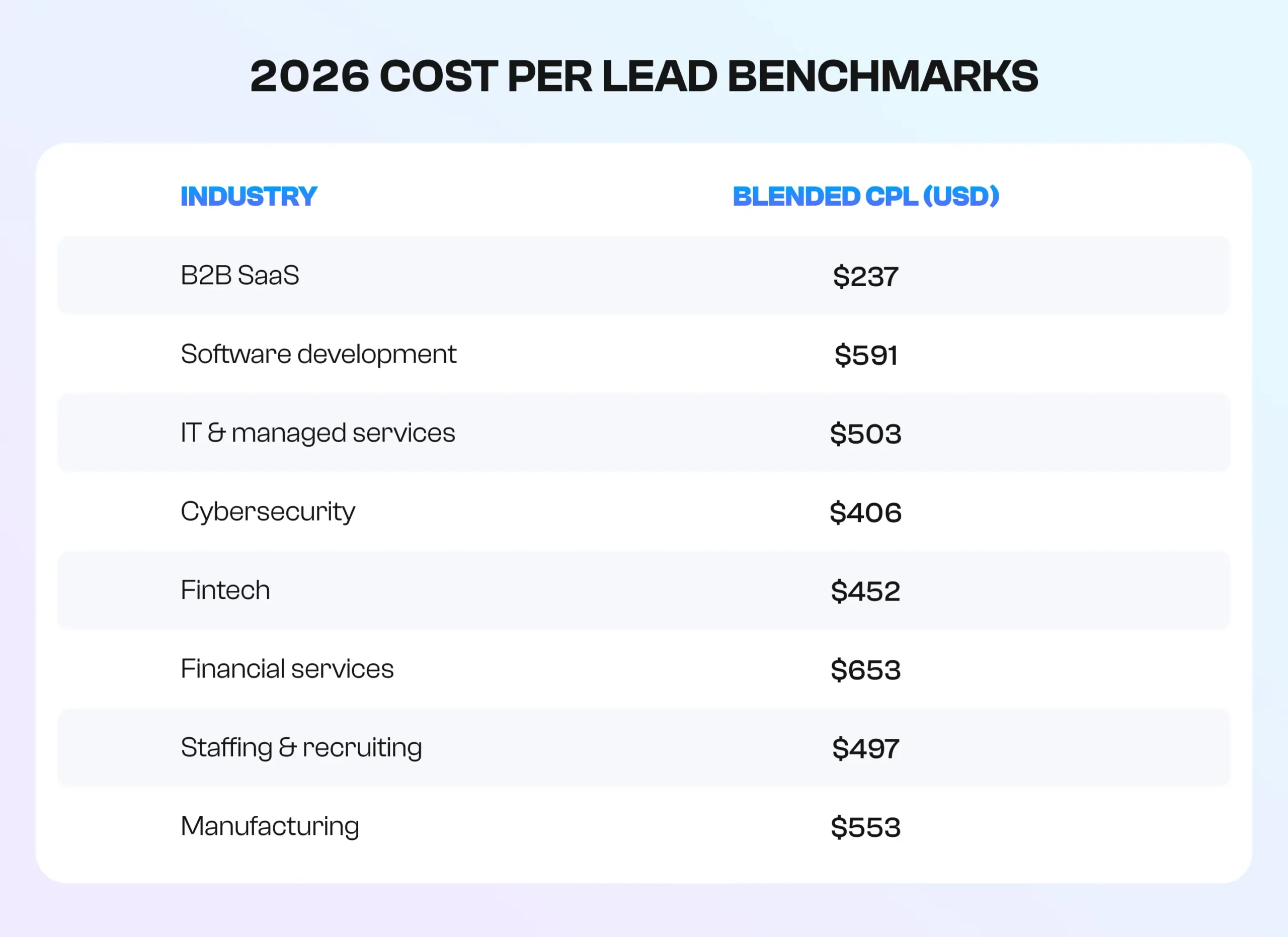
Cost per lead by industry varies more than most buyers expect. Here are the 2026 figures, with definitions spelled out.
How to Read These Numbers
The table measures marketing leads. Benchmarks built on higher-intent, sales-ready leads look very different: B2B cost per lead ranges from $420 to $3,080 across industries, with software and IT services at $1,680-$3,080. The two datasets count different things, so averaging them would produce nonsense. The B2B SaaS cost per lead of $237 describes an interested contact; a sales-accepted lead from an enterprise SaaS campaign can cost several times that. Regulated, high-ticket industries sit at the top because buyers are cautious and deals are large. Use these B2B cost-per-lead benchmarks as a range check, never as a target.

Industry sets the starting point; targeting sets the final bill. Across 650+ projects in 30+ industries, we’ve seen a manufacturing campaign aimed at plant managers in one country cost less per meeting than a SaaS campaign chasing CTOs across two continents.
In-House vs Outsourced Lead Generation Cost
Is lead generation agency pricing cheaper than hiring? You can only answer that by comparing total cost. Salary versus retainer tells you almost nothing.
What an In-House SDR Really Costs
One seat carries far more than a salary. Median base pay sits around $60,000 with on-target earnings near $85,000 in the US. Add manager time, recruitment, and a 3.9-month median ramp to 80% of quota (Bridge Group via Alba Talent, 2026), then data, infrastructure, Sales Navigator, CRM seats, and someone to write the sequences. Price in turnover too: 28% of SDRs leave within 12 months. Fully loaded, one SDR runs $110,000-$160,000 per year, roughly $9,000-$13,000 per month.
Total cost comparison
| Cost item | In-house (one SDR) | Outsourced program |
|---|---|---|
| People | SDR at ~$85,000 OTE plus manager time | SDR, researcher, strategist, account manager |
| Recruitment and ramp | Hiring cost plus ~3.9 months ramp | SalesAR launches within 7-14 days |
| Data and tools | Data provider, Sales Navigator, sequencing tool, CRM seats | Usually included (verify in contract) |
| Email infrastructure | Managed internally | Included and monitored |
| Copy, strategy, reporting | Internal marketing and RevOps time | Included, with weekly reports |
| Turnover risk | 28% leave within 12 months | Provider replaces team members |
| Typical total (USD) | $110,000-$160,000 per year | $2,500-$15,000+ per month |
When Each Model Makes Economic Sense
In-house wins when your product takes months to learn, when you already have SDR managers and tooling, or when you plan a team of five or more. Outsourcing wins when you need results in weeks, are testing a new market, or want several channels without hiring for each. Many companies run both. I go deeper in our piece on in-house vs outsourced lead generation.
How Much Should Your Company Budget?
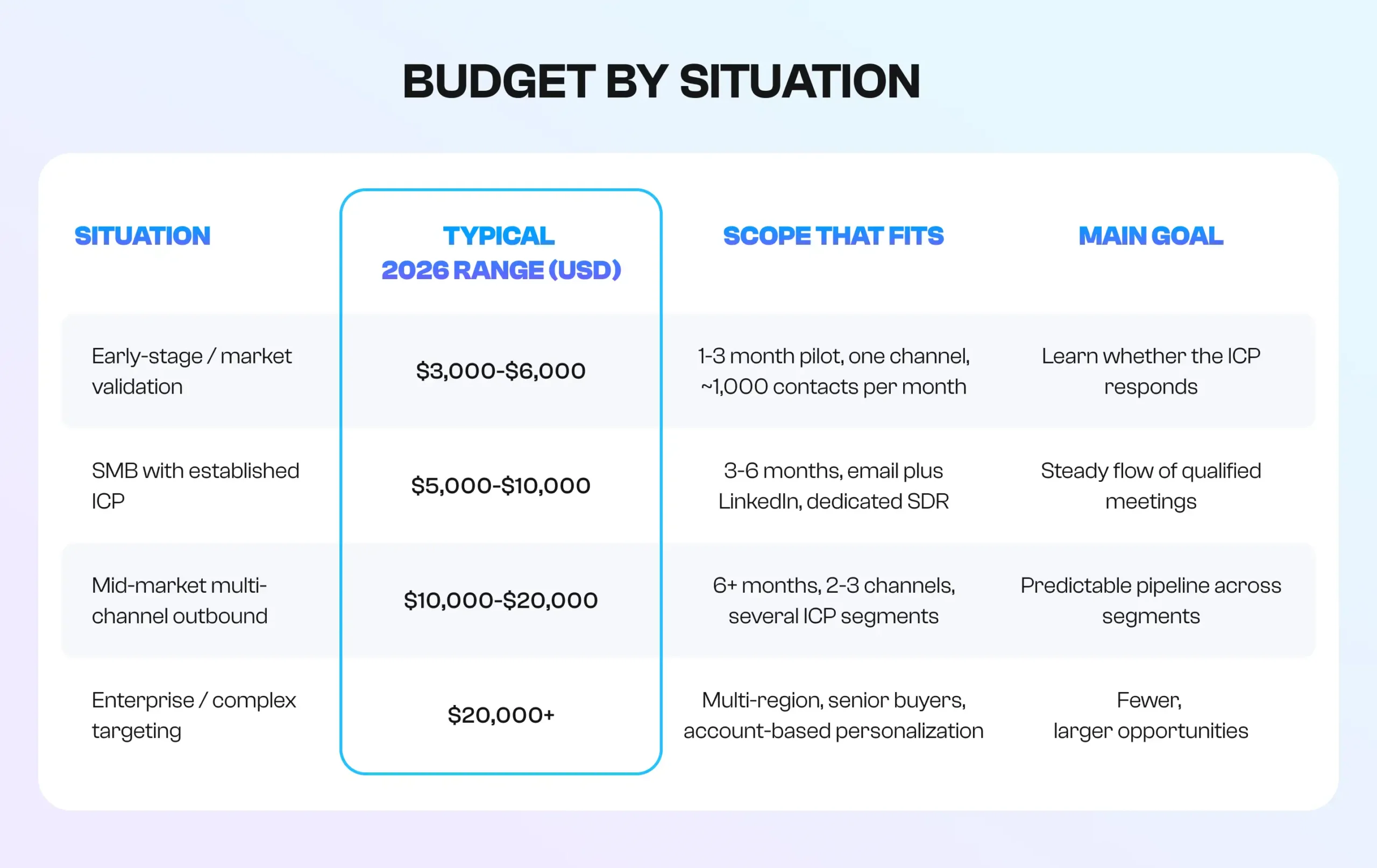
Asking for one universal number is like asking what a car costs. The useful answer segments the lead generation budget by situation.
What Moves the Budget up or Down
Up: senior buyers, several geographies, strict qualification, more channels, and a short deadline. Down: a sharp ICP, a recognizable brand, reusable data, and a single channel. My rule of thumb ties the budget to deal economics. If your annual contract value (ACV) is $30,000 and you close one in four qualified meetings, each meeting carries $7,500 in expected revenue. Pay a fraction of that per meeting, and the math works.
Book a quick call to explore tailored pricing options based on your goals, industry, and budget — and see how high-quality B2B leads can drive real results.
How to Calculate the Real ROI of Lead Generation
Lead generation ROI is simple to calculate and easy to get wrong. The fix is to measure cost at every funnel stage and compare it with revenue.
The Formulas You Need
Return on investment (ROI) compares what a campaign earned with what it cost:
- Cost per lead = total spend ÷ leads generated
- Cost per qualified lead = total spend ÷ sales qualified leads
- Cost per meeting = total spend ÷ qualified meetings held
- Cost per opportunity = total spend ÷ opportunities created
- Customer acquisition cost (CAC) = total spend ÷ new customers won
- ROI = (revenue from won deals − total spend) ÷ total spend × 100%
A Working Example
Say you run a three-month program at $8,000 per month, so $24,000 total:
| Stage | Result | Unit cost (USD) |
|---|---|---|
| Contacts reached | 4,500 | $5.33 per contact |
| Replies (6% reply rate) | 270 | $89 per reply |
| Interested leads | 120 | $200 per lead |
| Qualified meetings held | 45 | $533 per meeting |
| Opportunities created | 18 | $1,333 per opportunity |
| Closed deals at $25,000 ACV | 5 | $4,800 CAC |
| First-year revenue | $125,000 | ROI = 421% |
Measure on lifetime value (LTV), the total revenue a customer brings over the relationship, and a three-year LTV of $75,000 turns that into $375,000 on the same spend, an ROI above 1,400%.
Why Pipeline Beats Lead Volume
Now flip it. A different provider delivers 400 leads for the same $24,000, so $60 per lead, which looks three times cheaper. Those leads produce 10 meetings, 3 opportunities, and 1 deal. Cost per opportunity jumps to $8,000, CAC to $24,000, and ROI falls to 4%. Same spend, opposite outcome, which is why I ask about meeting, show, and opportunity rates before CPL. Our guide to the lead generation process walks through each stage.
How to Compare Lead Generation Providers
These questions help you evaluate lead generation service pricing fairly at any price point, so you know which scope you’re buying.
Questions About Scope and Price
- What exactly is included, and what is charged separately (data, domains, tools, cold calling)?
- Who owns the data, domains, and infrastructure when the contract ends?
- Which channels are included, and what does adding one cost?
- What are the contract length and exit terms?
Questions About Quality and Measurement
- How do you define a qualified lead, and can I see that definition in writing?
- How are meetings qualified, and what happens with no-shows?
- What reporting will we receive, and how often?
- What happens when the first targeting hypothesis fails?
- What assumptions sit behind your forecast: reply rate, meeting rate, show rate, opportunity rate?
A provider that answers all nine clearly has earned a second call, whatever its price. If you already run outbound, a lead generation audit gives you a baseline before you compare anyone.
How SalesAR Approaches Lead Generation Pricing
Here’s how we handle lead generation pricing at SalesAR, with the principles above applied to a real offer.
What You Pay for and What’s Included
Every package includes a dedicated SDR, a lead research specialist, an account manager, content writing with A/B testing, outreach mailboxes with anti-spam and domain health checks, appointment setting, metrics tracking, weekly reports, and weekly calls. Cold calling and CRM integration are add-ons, and we say so upfront. The full scope lives on our lead generation and appointment setting services page.
How Campaigns Are Structured and Scoped
We offer three lead generation packages: Pilot (one month, 1,000 contacts, built for testing), Business (three months, up to 6,000 contacts, two researchers), and Enterprise (six months, unlimited contacts, three or more researchers and two SDRs). Four workshops define the scope before you sign, so the offer reflects your ICP, geography, and channel mix. Outreach launches within 7-14 days, and free test contacts are available after the first call. Compare the options on our packages page.
How Results Are Evaluated
We track contacts researched, reply rate, meetings booked, and show rate weekly, and adjust targeting and copy based on the numbers. Akridata, a B2B SaaS platform selling to computer vision and AI teams in the US and EU, needed at least ten qualified appointments per month from a highly technical audience. Over four years, the campaign researched 55,000+ contacts, booked 297+ appointments, and held a 7% average reply rate across email, LinkedIn, re-engagement, and conference follow-ups. Read the full Akridata case study or browse our other case studies.

The most useful pricing conversation starts with your average deal size, your close rate, and how many meetings your sales team can handle each month. Those three numbers tell us which package fits and what a meeting is worth to you before anyone mentions a fee.
Final Thoughts
Lead generation cost in 2026 comes down to research, data, infrastructure, copy, SDR time, qualification, and reporting, priced for a particular definition of “lead.” Compare scope before price, cost per opportunity before cost per lead, and total cost before salary versus retainer. Do that, and how much lead generation costs turns into a better question: how much is a qualified meeting worth to my business, and who can deliver it reliably?
Book a consultation to discuss your requirements, or see SalesAR packages first.
FAQ
How much does B2B lead generation cost in 2026?
Most outsourced programs cost $2,500-$15,000+ per month on a retainer, and complex multi-channel programs reach $25,000. Pay-per-lead deals run $25-$400+, and qualified appointments cost roughly $300-$1,700. Industry, ICP, buyer seniority, and channel count decide where you land.
What is the average B2B cost per lead?
The average cost per lead in B2B depends on how you define it. For marketing leads, First Page Sage (2026) reports $237 in B2B SaaS, $406 in cybersecurity, $452 in fintech, and $553 in manufacturing. For higher-intent, sales-ready leads, put the range at $420-$3,080. Check which stage a benchmark measures before comparing.
How much does an outsourced lead generation agency cost?
Agency retainers in 2026 typically range from $2,500 to $15,000+ per month. The fee usually bundles research, data, email infrastructure, copywriting, SDR execution, and reporting. Lower quotes often exclude data, domains, or extra channels, so ask for a line-by-line scope before comparing on price.
How much does B2B appointment setting cost?
Performance-based providers charge $300-$750 per qualified meeting; the Clutch-reported average is $550-$1,700, and C-suite meetings exceed $1,000. The price reflects qualification criteria such as title, company size, and confirmed need. Our appointment setting services page explains how we qualify meetings.
What affects lead generation pricing?
Twelve factors drive most of the variation: industry complexity, ICP size, buyer seniority, geography, sales cycle, qualification requirements, channels, personalization, data requirements, campaign scale, team seniority, and technology. Each one changes either the research hours per contact or the touches needed per meeting, and both show up in your fee.
Which pricing model is best for B2B lead generation?
No single model wins everywhere. A monthly retainer suits ongoing outbound with a stable ICP. Pay-per-appointment suits teams that want booked calls only and have a written qualification standard. Project-based pricing suits pilots and market tests. Hybrid or performance-based pricing suits larger programs where both sides share risk. Match the model to your goal and risk tolerance.
Is outsourced lead generation cheaper than an in-house SDR team?
Often, though it depends on your setup. A fully loaded in-house SDR costs $110,000-$160,000 per year, while outsourced programs run $2,500-$15,000+ per month and include research, data, and infrastructure. In-house fits teams with existing SDR management, tooling, and a complex product. Outsourcing fits teams that need speed, multiple channels, or a market test.